BAS Editor Stephen M Hart
It feels almost surreal to find myself here in the Vatican Gardens awaiting the arrival of the Pope, this January day of 2026.
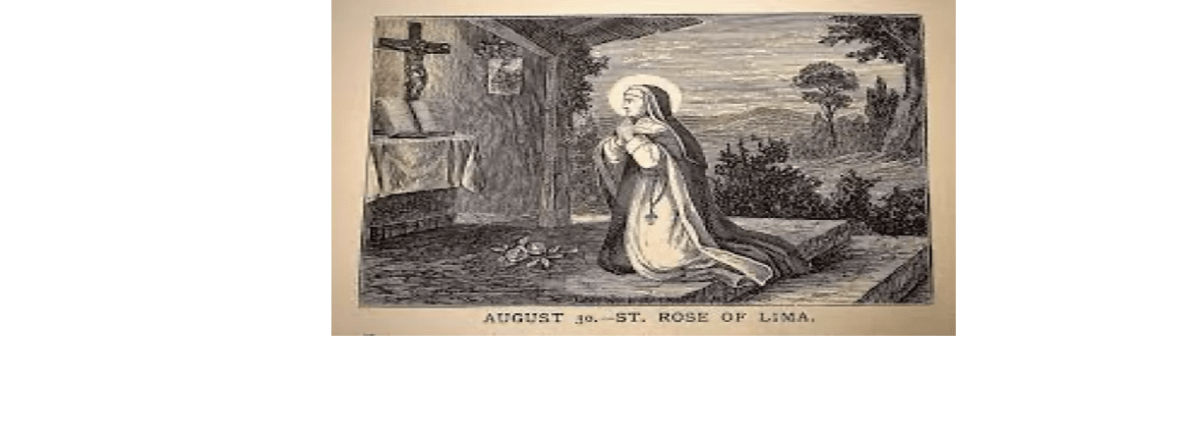
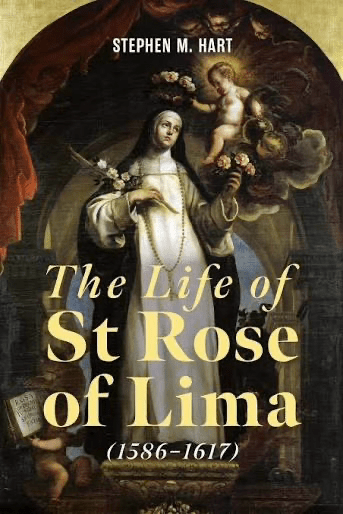
I am here for the ‘Enthronement’ of St Rose of Lima (1586-1617), the first saint of the Americas. I’ve been invited because I recently wrote her biography.1 Apparently this has not gone unnoticed by someone in high office…2
I first became interested in St Rose’s life and work in the summer of 2012 when – while attending a conference on the Peruvian poet, César Vallejo – I happened to stumble on her Santuario in downtown Lima, only a few streets away from the Hotel Bolívar where I was staying. My imagination was caught by the Santuario guide’s assertion that none of Lima’s abundant population of mosquitos ever bit the future saint.
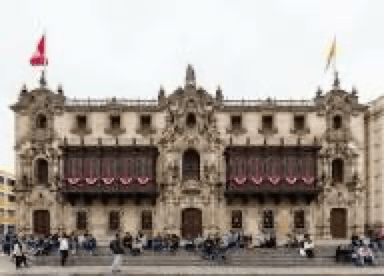
Later that day I visited the Archivo Arzobispal in Lima to look at the original copy of the Proceso Apostólico. That’s how I became hooked on the Santa Rosa de Lima story. How did she become the first saint of the Americas (canonised in 1671), the patron saint of the Americas, Peru and the Philippines, as well as fervently revered in the south of Holland and southern Italy?
I went on to write a critical edition of her Apostolic Process,3 based on archives in the Vatican Library, as well as a new biography in Spanish.4 In doing so I discovered a ‘second’ Apostolic Process in the Vatican archives, which I also published,5 as well as landing a Senior Research Fellowship funded by the Leverhulme Foundation.
And here I am, 14 years later, feeling distinctly nervous about the occasion. I have only just learned that Pope Leo himself will not only be attending the Enthronement, but also presiding over the event, an innovation for which – I am given to understand – special authorisation has been secured in the past week.
Ushered in through a small gate on the western side of St Peter’s, guided up a steep incline, past a now defunct railway line and astonishing mazes, I finally arrive in the beautifully manicured gardens.
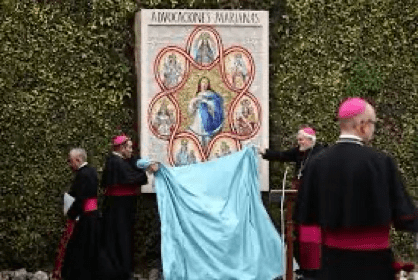
The front row of seating is already occupied by cardinals in their red zucchetti skullcaps. The other 400 or so devotos are mainly bishops, priests and nuns from Peru, along with civic dignitaries mainly of ambassadorial rank, high-ranking military officials, and staff members of the embassies accredited to the Holy See that have received an official invitation. Canopies have been erected to protect us from the rain that has been forecast.
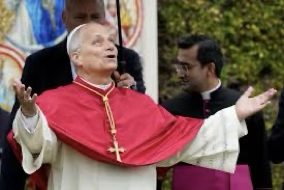
You could cut with a knife the nervous anticipation hanging in the air. All at once the cloudburst comes, but swiftly recedes before the advance of His Holiness Leo XIV – and here he comes. Relaxed, debonair, smiling broadly at everyone he encounters, he even jokes about the “blessing” of a good downpour.
He then addresses the gathering:
“Queridos hermanos y hermanas, nos reúne hoy un feliz acontecimiento, la inauguración de un mosaico dedicado a la Santísima Virgen, y de una imagen de Santa Rosa de Lima, aquí en los jardines vaticanos. Este gesto renueva los profundos lazos de fe y amistad que unen al Perú, como ustedes saben, un país tan querido para mí, con la Santa Sede.”
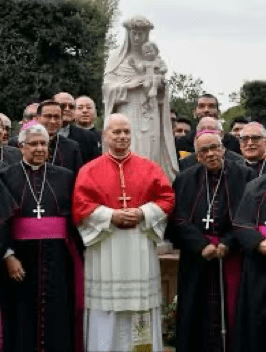
(“Dear brethren, we are gathered together today to witness a happy event, the inauguration of a mosaic dedicated to the Most Holy Virgin, and an image of St Rose of Lima, here in the Vatican Gardens. This gesture renews the profound links of faith and friendship which bring together Peru – as you know, a country I love so much – and the Holy See.”)
The Peruvians in attendance nod appreciatively. “Our Pope is American,” says one, “but his heart is Peruvian.”
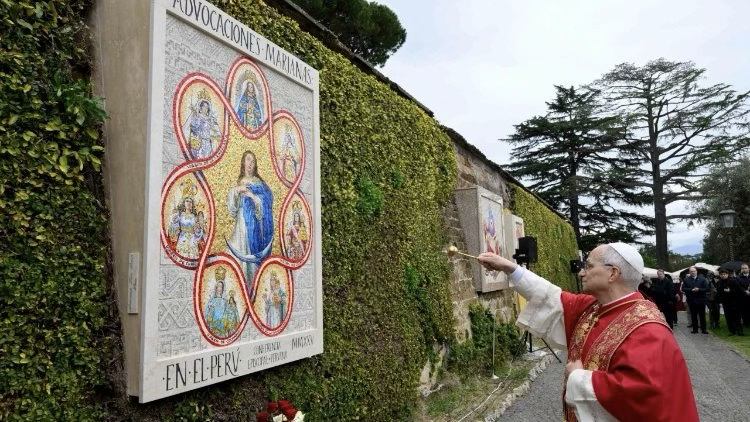
His Holiness goes on to affirm the continuing importance of the mission of the Catholic Church in the Americas, as epitomised by the figure of the Virgin Mary. To rapturous applause, he then unveils the mosaic and the statue.
Just as he is leaving, job done, a cry goes up. Could the Santo Padre bless the baby? His black limousine jerks to a halt, and out jumps the Pope. With another flash of that smile, he makes the sign of the cross over the child’s head. Then, in an instant, he is gone again, leaving the beaming mother trying to take in what has just happened.
The proceedings conclude with a magical-real lunch of Peruvian cuisine – ceviche and papas a la huancaína. This gives me the opportunity to consult no less an authority than the Archbishop of Lima about the theological meaning of the “enthronement”. Sipping our pisco sours, he explains to me that it signals the formal inauguration or exaltation of a spiritual figure, and is thus a worthy honour for the new Pope to confer on the Virgin Mary and St Rose of Lima.
- Stephen M. Hart, The Life of St Rose of Lima (1586-1617) (Woodbridge: Boydell and Brewer, 2026). ↩︎
- Stephen M. Hart, The Life of St Rose of Lima (1586-1617) (Woodbridge: Boydell and Brewer, 2026). ↩︎
- Hart, Edición crítica del Proceso Apostólico de Santa Rosa de Lima (1630-1632): Congr. Riti Processus 1573, Archivum Secretum Vaticanum (Lima: Cátedra Vallejo, 2017). ↩︎
- Hart, Santa Rosa de Lima (1586-1617): La evolución de una santa (Lima: Cátedra Vallejo, 2017). ↩︎
- Hart, Edición crítica del Segundo Proceso Apostólico de Santa Rosa de Lima “Rosa a Sancta Maria III Ord. S. Dominici: Supplementa Proc.” (1670): Congr. Riti Processus 2208, Archivum Secretum Vaticanum (Lima: Cátedra Vallejo, 2019). ↩︎

