Jasmine Wagon
It is tempting to see Spain’s Civil War (1936-39) as a struggle between fascism and democracy, but that would be an over-simplification. Whilst the Nationalists were united by Franco, the Republicans, a coalition of left-wing groups, suffered from ideological differences which fatally weakened their cause.
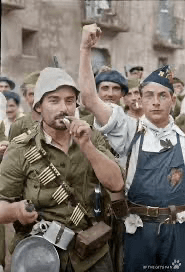
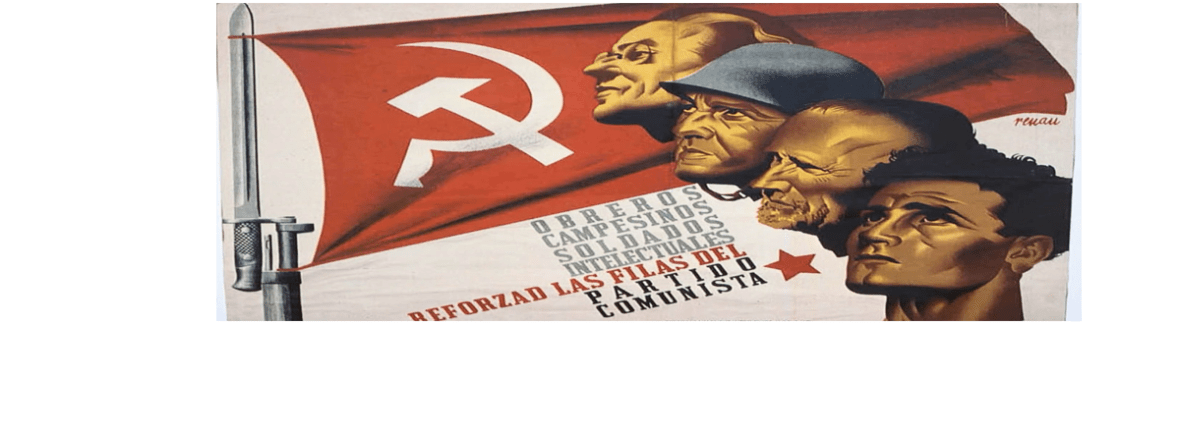
Featuring large in the anti-Franco Republican front were the socialists (PSOE) and communists (PCE). For them, fighting fascism and winning the war was the priority, a position supported by their backers in the Soviet Union. By contrast, the anarchists (CNT-FAI) and marxists (POUM) saw the struggle as an opportunity to push for social and political revolution, to include the collectivisation of shops, farms and other industries, and decentralisation of the state into self-governing communities.
George Orwell’s Homage to Catalonia provides a first-hand account of the ideological disunity among these groups. In Chapter Five, Orwell states “it is all very well to talk of ‘revolutionary purity’, but when one is fighting against the odds, the most essential thing is unity” – highlighting how divisions on the left damaged the Republic’s cause during the conflict.
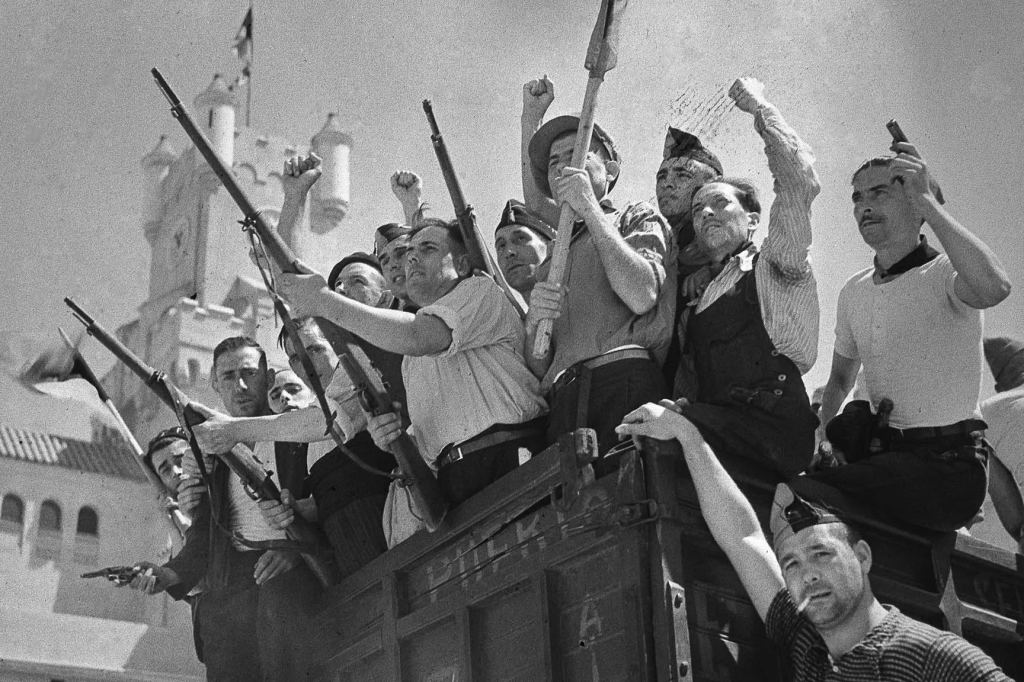
The Barcelona ‘May Days’ (3 – 8 May 1937), known in Spanish as the jornadas de mayo, or sucesos de mayo, revealed the deep ideological fractures within the Republican front. The conflict began when the Republican government attempted to seize the CNT-controlled telephone exchange in Barcelona, an act with profound implications for the anti-Franco alliance. This flashpoint became an ideological battle between the communists, who wanted to fight against fascism through centralised control, and the anarchists, who believed that revolution alone would win the war. Tensions erupted into long days of bloody violence on the streets of the city, turning allies into enemies and thereby weakening the Republican cause. Orwell recorded seeing “people who should be friends quarrelling over a difference of two or three words, and shooting one another dead about it.”
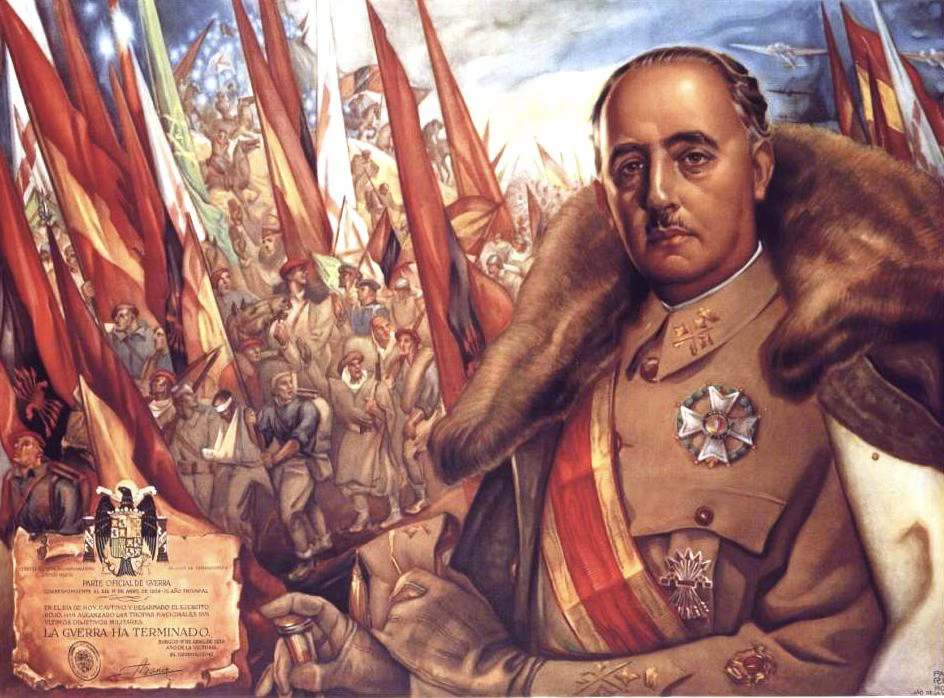
Harsh consequences followed from the May Days violence. Morale within the front collapsed, trust within the coalition was shattered, and, most dangerous of all, Franco was able to portray the Nationalists as the only hope for a coherent, united government. Increasing support from the Soviet Union led to intensified repression against the anarchists and POUM, further damaging the credibility of the Republican side.
The Soviet Union played an active role in supplying the Republican front with arms, but at the cost of political control. Stalin thought that a Bolshevik-style revolution in Spain would undermine his attempts to build co-operation with potential western allies against Hitler, such as Britain and France. His suppression of marxist and anarchist groups in the Civil War further deepened the ideological divide within the Republican front.
Unity wasn’t the only advantage the Nationalists had over the Republicans. Franco was able to purchase high-quality armaments from Italy and Germany through long-term loans, giving the Nationalists an abundance of military resources. By contrast, the Republicans had to pay Stalin in gold bars for weapons dating back to the Tsarist era.
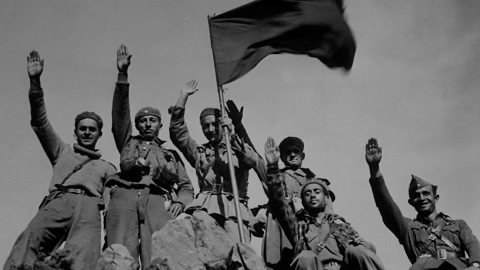
Nationalist troops were also better organised and trained in battle. Their command structure of experienced army officers under Franco’s leadership helped to consolidate their advances on the battlefield. Nonetheless, the Nationalists also had their ideological divisions. The Falange wanted a fascist dictatorship similar to that of Hitler or Mussolini, while the royalists sought restoration of the monarchy. There was even a Carlist faction that wanted to establish a separate royal dynasty. Franco took care to humour these competing forces without aligning himself too closely with any of them, thereby preventing any faction from becoming alienated and breaking away.
We can therefore conclude that Franco’s victory in the Civil War was not only down to his well equipped troops and clear leadership, but also to the fractured fronts of the Republic. A united cause was something they lacked from the start, thereby leaving the way open for a Nationalist triumph. This sealed the Republicans’ defeat, and determined the nature of Spanish society for decades to come.

