BAS Editor William Chislett
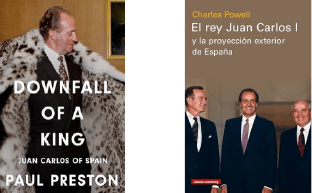
The contrasting sides of Spain’s former King Juan Carlos are graphically shown on the cover of two recently published books.
In Paul Preston’s Downfall of a King (William Collins), the King is wearing and admiring a coat made from the fur of a rare snow leopard, presented to him in 1998 by President Nursultan Nazarbayev of Kazakhstan during an excursion involving wild goat and ibex hunting and lavish social events.
In Charles Powell’s El rey Juan Carlos I y la proyección exterior de España (Galaxia Gutenberg), a beaming Juan Carlos is flanked by Presidents George H. W. Bush and Mikhail Gorbachov at the 1991 Madrid Peace Conference, which turned out to be the last summit held by the US and the Soviet Union before the latter’s collapse.
The immensely popular King was riding high at the time of the summit. As Franco’s successor as head of state since 1975, Juan Carlos had overseen Spain’s transition to democracy—bravely facing down an attempted coup in 1981—and was bestriding the world stage.
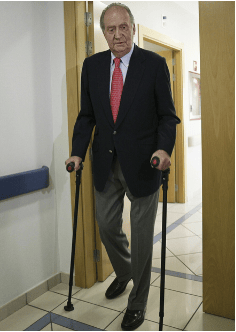
Fast forward to 2014, when, in poor health (17 operations), he abdicated in favour of his son Felipe following a secret, ill-judged and pricey elephant-hunting trip to Botswana in 2012 with his former lover Corinna Larsen. Spain was in recession, unemployment was 24%, and a corruption investigation was underway for which the King’s son-in-law was subsequently jailed for almost six years. The first Spaniards knew about the trip was when Juan Carlos had to be flown home on an emergency air ambulance after fracturing his hip in a fall.
Six years later, embroiled in alleged financial irregularities, including receiving a $100 million “gift” from Saudi Arabia, Juan Carlos, by now a toxic asset for the monarchy, was obliged by his son to go into exile in Abu Dhabi. There he remains. Investigators found insufficient evidence to prove the “gift” was a kickback for helping to secure a mega high-speed rail contract for Spanish companies.
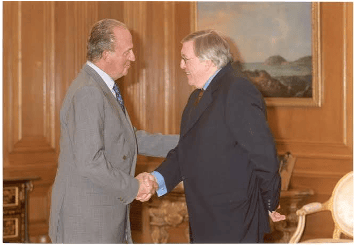
Preston’s book is an update of his Juan Carlos: A People’s King (HarperCollins) published in 2004 when the King was still held in relatively high esteem, although his private life of marital infidelities and a penchant for high living was already an open secret. That book concentrated on Juan Carlos’s strict upbringing under Franco and the dictates of his regime, the machinations that led the dictator eventually to appoint him his successor and thereby restore the Bourbon monarchy—in the apparent belief that Juan Carlos would continue the Franco regime— and how the King piloted the transition, consolidated democracy and, with it, ensured the monarchy’s survival.
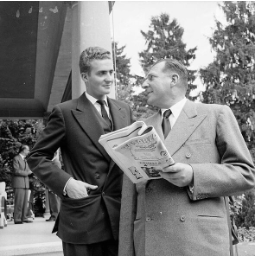
In 1947, less than a decade after the end of the Civil War, the 10 year-old Juan Carlos had arrived in Madrid by train from Portugal, where his father, Don Juan, lived in exile. Don Juan’s father, Alfonso XIII, had gone into exile in 1931 on the eve of the proclamation of the Second Republic. Preston says the lonely boy had effectively been ‘sold…into slavery’, and became a chess piece in a drawn-out strategy.
The liberal Don Juan was furious when Franco chose Juan Carlos to succeed him. Franco’s decision gave Juan Carlos no alternative but to accept and swear allegiance to the regime’s principles. Years later, in May 1977—a month before the first free general election since 1936 – Don Juan saw that democracy was indeed being restored by his son, and so renounced his own dynastic right to the throne.
Preston is always an engaging writer, though the last two chapters covering the King’s downfall make for sad reading. Perhaps Juan Carlos felt that after a life of sacrifices he could lead one of indulgences. Preston’s overall judgement is that the King’s achievements far outweigh his misdemeanours. It would be a pity if he was remembered only for the latter.
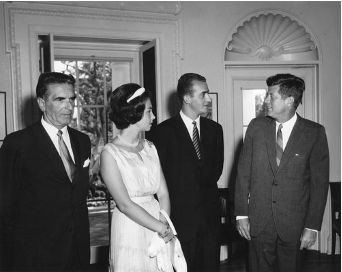
While Juan Carlos is best known for his role in restoring democracy, scant attention has been paid to the significant part he also played in ending Spain’s international isolation, something that began even before Franco designated him his successor (in 1969). By then Juan Carlos had visited 33 countries, meeting, among others, US Presidents Kennedy and Johnson.
The King used the immense powers inherited from Franco to play a major role in defining and implementing foreign policy. And after 1978 the Constitution’s vague description of the head of state’s role in foreign affairs gave him more leeway than heads of state in other parliamentary monarchies. By the time Juan Carlos abdicated, he had made 275 state, official and working visits in his 39-year reign. In contrast, Franco made just three official visits abroad during his 39-year regime –to meet Hitler, Mussolini and Petain– plus a single state visit to Portugal (at the invitation of fellow-dictator Oliveira Salazar).
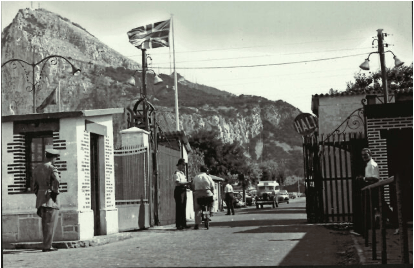
The King helped lift two vetoes that significantly conditioned Spain’s EEC membership. The first was imposed by the British government, which established a direct link between (1) the full restoration of communications between the British overseas territory of Gibraltar and Spain, and (2) future approval of Spain’s accession treaty by the UK parliament. Franco had closed the border with Gibraltar in 1969 and cut off telephone communications. Juan Carlos let it be known sotto voce that Spain was not seriously seeking to regain sovereignty, although the official discourse, for longstanding domestic consumption, was otherwise. The border was reopened before Spain joined the EEC in 1986.
The other veto was the refusal of some EEC member states to allow Spain to join the bloc unless it first established diplomatic relations with Israel. Juan Carlos used his close relations with some Arab leaders, particularly King Fahd of Saudi Arabia, to make them realise Spain had no option.
Powell’s exceptionally well-documented and enlightening book is largely based on declassified US and UK diplomatic cables and documents, as well as interviews with the main protagonists of Spain’s foreign policy, including Juan Carlos and the country’s past prime ministers. But for Spain’s archaic official secrets law, which has hardly changed since it was approved by Franco in 1968 and is unworthy of a democracy, the book would have been even more superbly documented. The absence of declassified Spanish documents among the 1,357 footnotes in the book speaks volumes about the continued lack of transparency in Spain.
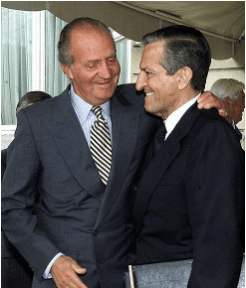
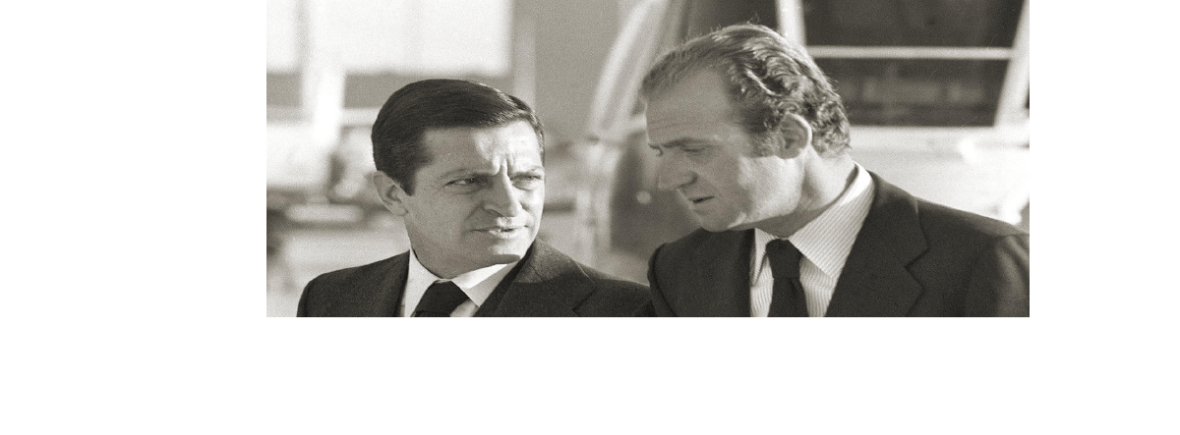
Juan Carlos’ role in the transition cannot be spoken of without that of Adolfo Suárez (1932-2014), who died shortly before the King abdicated. Juan Carlos appointed him Prime Minister in 1976 after sacking the disastrous Carlos Arias Navarro, Franco’s last Prime Minister, who was kept on in order to calm the dictator’s staunchest supporters in the heady months after Franco’s death. Juan Carlos and Suárez, a former Minister of the National Movement, the only legal political organisation, worked hand in glove. Six years older than the King, Suárez, like Juan Carlos, was not identified with the Civil War, unlike Arias Navarro, who was a prosecutor in military tribunals in Andalusia after the conflict and known as the “butcher of Malaga”.
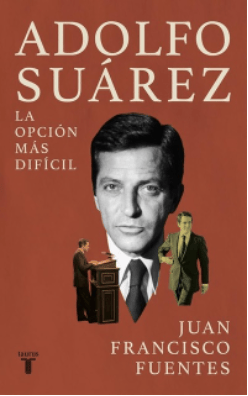
Juan Francisco Fuentes’ absorbing biography—Adolfo Suárez, la opción más difícil (Taurus)—traces the rise of this relatively unknown and immensely simpático apparatchik. Suárez caught Juan Carlos’s eye when he was civil governor of Ávila and later head of the state-run television. His appointment as Prime Minister prompted an op-ed in El País by the Francoist historian Ricardo de la Cierva titled “¡Qué error, qué inmenso error!” which proved to be famously wrong. Fuentes is right to call Suárez “la opción más difícil”, but it soon became clear that he was also the perfect option as he knew the regime inside out and thus understood how to destroy it from within.
William Chislett’s new book, 50 años después: Los profundos cambios en España desde la primeras elecciones democráticas (Espasa) will be published in January 2027.
For the Bulletin’s 2020 interview with Paul Preston about his biography of Juan Carlos, see :

