Our Americas Editor Clara Riveros speaks with Mexican journalist and writer Julio Patán about the President’s first six months in office.
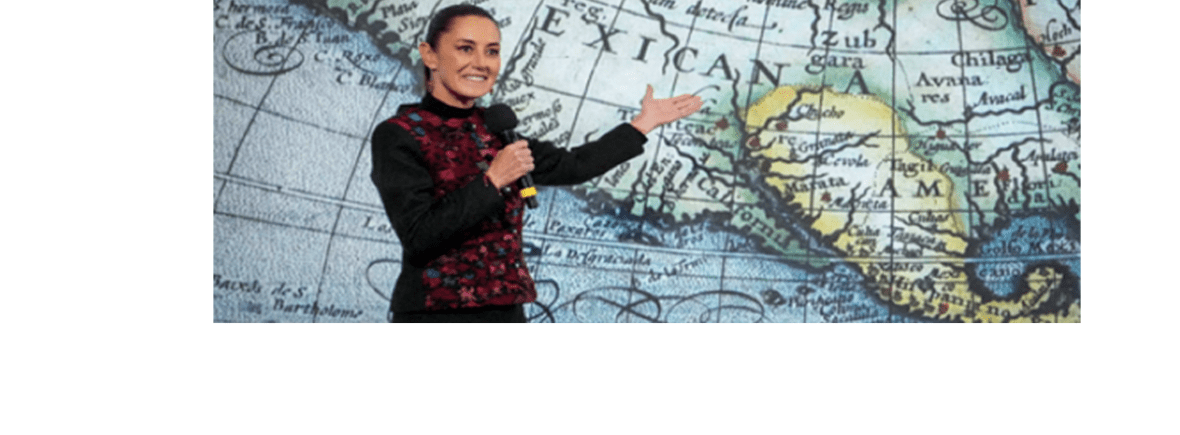
Claudia Sheinbaum is the first woman to lead Mexico, the second-largest economy in Latin America, whose population of nearly 130 million makes it the country with the largest number of Spanish speakers in the world.
As Presidenta she is charting a course between pragmatism and the populist left, raising concerns as to whether she will run aground or navigate her way through.

Julio Patán (Mexico City, 1968) is one of Mexico’s most influential journalists, renowned as a writer, philosopher, radio and television host. Acerbic, incisive, and lucid, as his books attest, I found his writing a great help in getting through the pandemic.
At the end of April we connected online to discuss the first six months of President Sheinbaum’s six year term.
AMLO and Destroying to Create
Looking at Mexico today leaves no room for doubt about just how disastrous was the 2018-2024 administration of former President Andrés Manuel López Obrador (AMLO), according to Julio Patán. “AMLO’s security policy was basically complicity with organized crime, whether by omission or, at some levels of his government and his party, open complicity with criminals”.
AMLO’s term will also be remembered for the 800,000 deaths from COVID, which to many Mexicans is unforgivable. They remember that, for decades, the Mexican vaccination system was a global model. “Now there aren’t enough vaccines, and diseases that had been eradicated have reappeared: we have cases of measles and whooping cough—all of this the legacy of the previous government”.
AMLO’s policies were also a disincentive to investment – hardly surprising when, on the one hand, the country is held hostage by organised crime and, on the other, as a businessman, if you have a dispute with the government, it’s now going to be resolved by a judge who is a member of the ruling party. “You’d be better off investing in Afghanistan,” Patán quips. “The problem is that, when the world’s political leaders are Vladimir Putin, Donald Trump and others, AMLO doesn’t seem so terrible…”

Another major issue is public education and the concessions made to the “extortionist” organisation known as CNTE, the National Coordinator of Education Workers, which split off from SNTE, the National Union of Education Workers. CNTE has been a mass movement of the far-left whose influence was especially strong in the south of the country and in the poorest states. Its detractors portray it as primarily dedicated to blocking roads and exerting pressure, through unorthodox methods, to extort the government and obtain benefits. Patán remarks that President Peña Nieto [2012-2018] “had CNTE contained, albeit through heavy-handed measures. AMLO, on the other hand, made endless concessions and even put CNTE in charge of new educational reforms. He gave into it on tenure and salary increases. Now it’s out of control, and we have calls for general strikes.”
The Sheinbaum quickstep: one step forward, one step back
Patán points to Sheinbaum’s new approach to public safety as a positive change in the past few months. “The federal government is doing well, and its strategy now is very different from AMLO’s, but the truth remains that the security situation is out of control”.
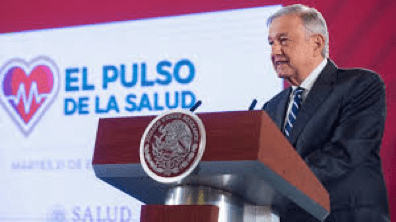
Another problem that the Sheinbaum administration is addressing as best it can is the shortage of medicines in the public health system. This isn’t new: governments of the PAN and PRI parties also experienced this, but the truth is that it exploded under AMLO “due to the populist tendency to reinvent the world. AMLO dismantled the procurement system and accused the companies that managed it of corruption. So too with the distribution system for medicines: it worked reasonably well, but AMLO tore it to pieces and left a sad legacy, for example, of children with cancer and people without treatment for HIV. There were massive protests, of course. Now they’re trying to go back to what existed before AMLO, but without acknowledging it in so many words, because AMLO and Sheinbaum are part of the same thing [the MORENA political movement]. Destroying the healthcare system took less time than it will take to rebuild it; developing that distribution system took many years.”
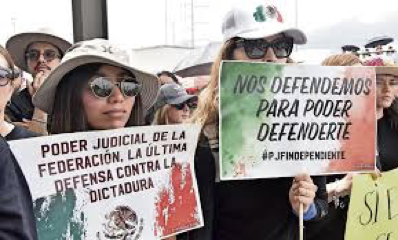
Patán regards Sheinbaum’s “worst decision so far” as her support for reform of the judiciary. “This is nothing less than a coup d’état,” says Julio Patán. “From 1 June we’re going to see judges and magistrates elected by popular vote. We have the precedent of Bolivia, which opted for this path, and it was catastrophic for democracy and the separation of powers in the country. I call it a coup because the candidates were imposed by both chambers of the legislature (controlled by the ruling party) and by the presidency. MORENA, the political movement of AMLO and Sheinbaum, is effectively absorbing the judiciary, thereby dynamiting the independence of branches that is fundamental to the existence of democracy. This was AMLO’s last major decision before leaving power, and it looks like the end of Mexican democracy, with all its flaws”.
The collapse of the opposition and populism to maintain power
Against this backdrop, it seems strange that AMLO’s political heiress won an even higher vote-share in 2024 than he did in 2018. Patán explains this with reference to huge pre-election hand-outs in so-called “social programs” for the elderly, unemployed youth, mothers, etc. These programs amounted to “cash for votes. Populism understands very well that immediate give-aways will always count for more than long-term considerations, but when money stops circulating and investments go elsewhere, then comes the reality check – ‘now enjoy what you voted for’.”

And so it happened that the MORENA movement of AMLO and Sheinbaum took over the country. “There are broad sectors of Mexican society that warm to this authoritarian way of governing, with its caudillismo and populist style. It’s to do with our history, with its many centuries of authoritarianism, even with the nature of the Spanish colony. And then also with the lack of responsiveness of the opposition parties”.
Indeed, the opposition has effectively collapsed. The PRI has hit a new low, discredited by corruption and bled dry by internal feuds. The inept leadership of the right-leaning PAN, which governed twice and continues to govern some states, has driven out and alienated its best talent.

With these main opposition parties almost dismantled, “the citizen votes for what’s there. And opposition leader Xóchitl Gálvez’s campaign was very bad. I thought she could attract a mass of votes, but she didn’t know how to do it. She had no ideas. There were many things wrong with her campaign. Now the opposition is internal.” In other words, MORENA and its internal and internecine power struggles: “Troglodytes in the House and Senate are secretly confronting those closest to the President, whose faction is more inclined to the woke movement – she being more reformist and surrounding herself with younger, university-educated people. The same thing happens in the states, sometimes more savagely, as in Tabasco, the president’s birthplace. But, again, if the opposition is dead, you vote for what’s there.”

When AMLO was in power he made it clear that he didn’t want to be a high profile figure in international affairs. He maintained a folksy, provincial style, hardly ever leaving the country during his term. In the six months that have passed since his presidency nothing has been heard from him. There are rumors that he went to Cuba, but Julio Patán doesn’t believe them. Some suggest he did what he said he would do: retire to his family ranch, “La Chingada.” Still others say he’s in Mexico City, in the southern suburbs.
The truth is that AMLO has been a skilful political operator and still exercises control behind the scenes. He dominated the media and news agenda for the six years of his term, despite his modest academic, intellectual, and professional background (it took him 18 years to complete his degree in Political Science at UNAM). His level of influence is evident, and he left key people who are religiously loyal to him in positions of power in the Chamber and the Senate. “He is the absolute leader of the movement. He will stop any initiative of the President that doesn’t satisfy him. He’s astute, rather than intelligent; he knows the intrigue, the internal politics, and national politics well.”

Sheinbaum, for her part, has a more solid academic standing and a history of strong activism on the hard left, unlike AMLO, who was initially a member of the PRI. With these credentials, it is surprising that in various aspects she is so pragmatic, and almost scientific and rational in her approach to politics. She demonstrated this, for example, in her handling of the pandemic as Mayor of the city, and now in her far from easy negotiations with Donald Trump. “Sheinbaum understands the need for free trade, for a free trade agreement with the US, for investment. She deals with Trump with great restraint, and that has been her greatest achievement so far.”
Nonetheless, Julio Patán’s abiding message is concern over the judicial reforms – evidence, he says, of the hold of the extreme left over Shainbaum’s administration. “It was AMLO’s idea, but she has backed it. It’s the end of the separation of powers in our country…and without that, there can’t be democracy.”
 Bulletin of Advanced Spanish