BAS Editor William Chislett
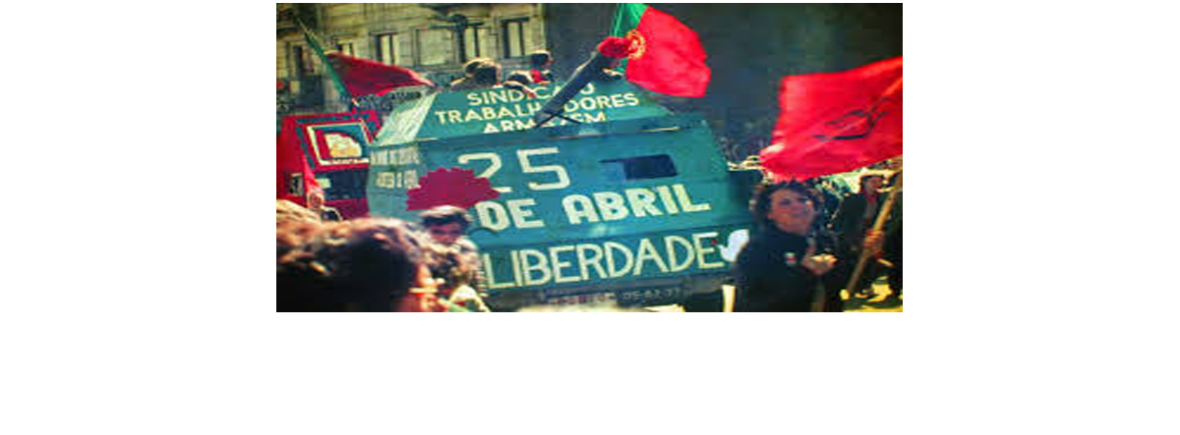
Little did they know it, but the military captains who overthrew Portugal’s decades-long dictatorship on 25 April 1974 ushered in a wave of democratisation around the world, including Spain after the death of General Franco in 1975, but in very different circumstances.
Portugal’s dictatorship was the oldest in Europe, totalling 48 years since the 1926 military coup against the chaotic First Republic and 41 years since the authoritarian Estado Novo established in 1933 under António de Oliveira Salazar.
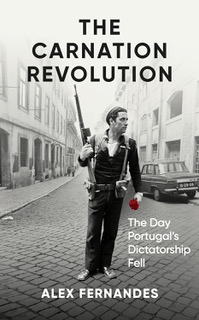
What led to the coup against Salazar’s successor, Marcelo Caetano, how it unfolded and its turbulent aftermath, when Portugal might have gone down the road of communism, is brilliantly and evocatively told in Alex Fernandes’ gripping book Carnation Revolution (Oneworld Publications). The main driver of the rebellion was widespread discontent in the armed forces caused by the unwinnable 13-year conflict in the Portuguese colonies of Angola, Guinea-Bissau and Mozambique, which drained lives, morale and resources. The secret signal for the uprising to begin came when a radio station broadcast the popular song Grândola, Vila Morena. Citizens greeted the coup by giving carnations to soldiers, which they placed in the barrels of their guns.
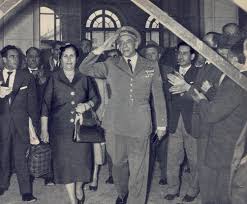
While in Spain no serious attempt was made to challenge Franco from within his regime and there were no elections for head of state, Portugal’s (fraudulent) 1958 presidential election saw General Humberto Delgado run against the candidate supported by Salazar. Delgado subsequently went into exile. In 1965 he was killed just over the border in neighbouring Spain after being lured there by agents of the Portuguese secret service PIDE whom he believed were opponents of the regime.
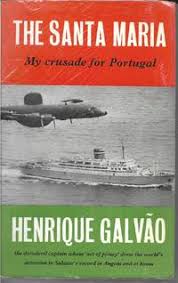
Nevertheless, unrest had taken root among the military command. In 1961, when the colonial conflict with nationalist movements began, a group of commandos, led by Captain Henrique Galvão, seized the luxury Portuguese cruise liner Santa María in the Atlantic in an effective propaganda coup against the dictatorship. More and more officers from the upper classes and their children moved into civilian jobs in the colonies in the late 1960s, thereby reducing their chances of premature death, leaving vacancies in the more junior ranks to be filled by young men from working class families from the mainland. Most of them had never left Portugal and were confronted with what Fernandes calls ‘the multifaceted reality of Portuguese colonialism, marked by racism, sexism, cruelty and institutional corruption’. The gulf between the regime’s propaganda machine spouting that the war was going well and the brutal reality was huge.
Back on the mainland expressions of dissent were becoming more daring. One of the most memorable was the release of two pigs dressed in admiral’s uniforms in central Lisbon to protest at the re-election of Admiral Américo Tomás as President for the third time in sham elections. The pigs were so oiled that the police could not grab hold of them and had to shoot them.
Conscription laws brought more and more young adults to the battlefield from the mainland, as well as anti-regime students from the colonies. ‘In the 1950s, Portugal exported revolutionaries, radicalised under its nose, back to their homes in the colonies. Over two decades later, the colonies paid back the favour: now the Homeland’s soldiers return dreaming of a revolution’. Spain, too, experienced student unrest.
Some officers stationed in multinational bases abroad, as a result of Portugal’s membership of NATO since its creation in 1949, came into contact with democracy. As well as NATO, Portugal also benefited from the Marshall Plan. Spain, more of a pariah, was barred from both (it did not join NATO until 1982). During World War Two neutral Portugal had closer ties with the US than Spain (in 1943 the US was granted use of the Azores as a strategic stop for its aircraft and ships). Spain was also non-belligerent, but exported wolfram, a key element for the manufacturing of armaments, to Nazi Germany, and sent the Blue Division, a voluntary unit of 45,000 personnel, to the Eastern Front to fight against Soviet Russia. Franco also met with Hitler.
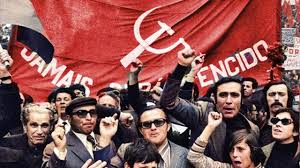
During the Cold War, both staunchly anti-communist countries were important for the US, which established military bases in the Azores and in Spain. Ironically, it was communist parties that spearheaded the civilian opposition to the dictatorships in both countries.
In Portugal, the military’s discontent gave rise in September 1973 to the Movement of Captains (subsequently called the Armed Forces Movement, MFA), whose first meeting of 136 junior officers was held secretly near Évora (exactly a year later, a small group of Spanish officers formed the Democratic Military Union, UMD). There was anger not just at the waste of the war, but at new ordinances (subsequently repealed) which allowed a militia officer to take a rapid two-semester course and acquire the same status and rights as a permanent officer who had undergone the full four-year course. This erosion of staff officers’ prestige was paradoxically a catalyst for finding common ground among the disparate elements in the MFA.
The final blow for the regime was the publication in February 1974 of a book by General António de Spínola, Vice Chief of the Armed Forces, arguing for a political and not a military solution to the colonial wars, which would only be possible in a democratic Portugal. Spínola, never seen without his cane, lambskin gloves and monocle, was sacked.
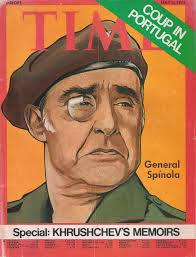
The April 1974 coup was virtually bloodless, apart from the four people shot dead when a crowd gathered in front of the PIDE’s headquarters, and one PIDE agent. The first two years after the revolution were turbulent, with six provisional governments, endless strikes, takeovers of large estates and factional fighting in the armed forces between leftists and conservatives. The conservative Spínola, known as the ‘Old One’ (he was in his 60s), collided head-on with the much younger radicals in the MFA, especially over how to achieve decolonisation. In March 1975 he attempted a coup, but it failed and he was exiled to Brazil. This was followed on 25 November, five days after Franco’s death, by a left-wing coup, quickly put down in a counter-coup.
By this point Portugal was at last ready to move from a revolutionary to a constitutional process and a pluralist democracy. Its revolution was closely watched in Spain by opponents and supporters of the regime alike. According to urban legend, General Manuel Díez-Alegría, the relatively liberal chief of the Spanish army staff, was sent a monocle after the revolution, a symbolic way of asking him to assume the role played by Spínola.
Spain’s transition to democracy was very different. Franco died with ‘his boots on’. He was not overthrown. There was political violence against the regime, and it did not end with the dictator’s death. The Basque terrorist group ETA killed 20 people before and more than 800 after Franco died, only ending its armed struggle for an independent Basque country in 2011.
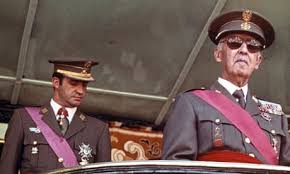
The Spanish transition was engineered in a pact between the reformist right and the non-violent left using Francoist ‘legality’ to dismantle the 36-year dictatorship, installed after Franco won the civil war in 1939. It was both a top-down process, animated by King Juan Carlos under a parliamentary monarchy, and bottom-up from the streets with social mobilisations. Democratic elections were held in June 1977 and a new constitution was approved by parliament in October 1978.
Both countries joined the then EEC in 1986 and have undergone profound socio-economic transformations. While the population of the much larger Spain has increased by more than 14 million since 1975, largely fuelled by immigrants, Portugal’s only rose by just over one million (see Figure 1). The per capita income of Portugal, even poorer than Spain 50 years ago, has grown proportionately more than its neighbour, while life expectancy in both countries is among the highest in the world. Their economic structures have followed a similar path: the agricultural and service sectors’ share of GDP today is almost the same. Portugal’s unemployment rate is just over half that of Spain’s and the country has also been much more successful in reducing the early school-leaving rate from very high levels. Spain has become more feminist than Portugal, judging by the large proportion of female MPs (44% of the total).
Figure 1. Socio-economic data, Portugal and Spain, 1975 and 2023
| Portugal | Spain | |||
| 1975 | 20231 | 1975 | 20231 | |
| Population (mn) | 9.0 | 10.2 | 35.8 | 48.0 |
| Under 15 (%) | 27.0 | 13.0 | 27.0 | 14.0 |
| Over 65 (%) | 11.0 | 23.0 | 10.0 | 20.0 |
| Life expectancy at birth (years) | 68.0 | 81.1 | 73.0 | 83.2 |
| Per capita GDP (current US$) | 2,127 | 26,880 | 3,209 | 33,090 |
| Structure of GDP (%) | ||||
| Agriculture | 12.0 | 2.5 | 9.6 | 2.6 |
| Industry (including construction) | 39.6 | 22.7 | 39.1 | 22.8 |
| Services | 48.4 | 74.8 | 51.3 | 74.6 |
| Unemployment (%) | 4.0 | 6.6 | 4.8 | 11.7 |
| Gross public debt (% of GDP) | 19.2 | 103.4 | 11.9 | 107.7 |
| Tax burden (% of GDP) | 19.7 | 36.4 | 18.4 | 38.0 |
| Inward FDI stock (US$ bn) | 9.62 | 177.3 | 65.92 | 787.3 |
| Outward FDI stock (US$ bn) | 0.812 | 62.9 | 15.62 | 550.7 |
| International tourists (million) | N/A | 18.3 | 30.0 | 85.1 |
| 15-29 year-olds not in employment, education or training | N/A | 3.9 | N/A | 12.7 |
| Early school-leaving rate (% of population aged 18-24) | N/A | 6.0 | N/A | 13.9 |
| Cars per 1,000 population | N/A | 639 | N/A | 627 |
| Share of women in parliament (%) | N/A | 33.0 | N/A | 44.0 |
(1) Or latest available figures.
(2) UNCTAD’s figures for foreign direct investment began in 1990.
Sources: World Bank, Eurostat, OECD, IMF, World Tourism Organisation, Bank of Portugal.
If the number of governments over a certain period of time can be taken as a yardstick of political stability, then Spain with 17 governments since 1976 compared with Portugal’s 24 has been more stable. Both countries had essentially two-party systems. Spain’s ended in 2015 with the arrival in parliament of the would-be centrist Ciudadanos and the hard-left Podemos, followed in 2019 by the hard-right VOX, while Portugal’s ended this year when the hard-right Chega won 50 seats, up from 12 in 2022, making it, like VOX after Spain’s 2023 election, the third-largest party.
Political life in Portugal is less antagonistic than in Spain, where parliamentary debates and discourse demonise opponents. Spain’s two main parties, the conservative Popular Party (PP) and the Socialists, are in a permanent state of confrontation and ideological polarisation, to some extent the legacy of the Civil War.
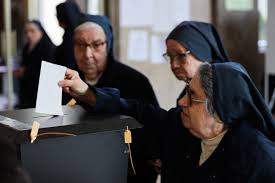
Portugal’s recent election, like Spain’s in 2023, produced no party able to govern on its own. The centre-right Democratic Alliance (DA) won, ousting the Socialists after eight years, but fell 36 seats short of the 116 required to form a governing majority, while Spain’s Socialists remained in office but were 55 short of a majority. Both countries therefore have minority governments that rely on support from other parties (a total of six in the current Portuguese parliament and 11 in Spain which, unlike Portugal, has regional parties – a marked difference).
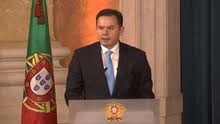
By vowing not to make any deals with Chega, Portugal’s DA leader and Prime Minister Luís Montenegro will have to seek support from the Socialists. In Spain the DA’s counterpart, the PP, has made deals with VOX at the regional and local levels in order to govern. Whether the PP would do this at the national level if the seats won by it and VOX gave them a majority at the next general election, not due until 2027, remains to be seen.
Spain’s two main parties could do with taking a leaf out of Portugal’s book and learn to cooperate. The political situation in Portugal will be closely watched in Spain.
Adapted from the version originally published by the Elcano Royal Institute in Madrid.
 Bulletin of Advanced Spanish