BAS editor Alfredo Benito
For the Spanish version of this article, click here.
Gypsies have a saying that they don’t want their children to have too good a start in life. And in Spain there is a proverb according to which what matters is not how something begins, but rather how it ends. Such earthy wisdom is often grounded in experience. So it is with the starred career of Rafael Nadal, which reflects something of both sayings – but only something.

Let’s go back in time, to 11 September 2001. No, that is not a mistake. On the morning of one of the most infamous days in human history, Nadal was playing in the Futures tournament in Madrid. It was his first match as a professional, against fellow Spaniard Guillermo Platel-Varas. Nadal was 15 years old, and would soon chalk up his first win and first ATP points. But in this match against his fellow-countryman, the lad from Mallorca lost 13 match points and with them the chance of victory.
If that can be called the epitome of a bad start, his first dealings with the tournament that would take him to the top of tennis – Roland Garros – did not go much better. In 2002, still a junior, he gave priority to taking his GCSE Spanish exam; and for the two years after that, a cracked elbow and a broken ankle prevented him from even playing in the qualifying round.
However, everything was going to change very quickly. He notched up his first ATP points just one week after that fateful September day, and his first victory on the ATP tour came on his home patch in Mallorca that same year. In 2004 he reached his first final (in Auckland). His first ATP trophy came later that year on the clay of the Polish tournament in Sopot, where he defeated an Argentine opponent – a nationality he would come across repeatedly in his early big wins.
2004 is the year which many consider the start of the Nadal ‘legend’. The occasion: the Davis Cup. The place: Seville. This iconic team event had historically been a nightmare for Spanish tennis, which year after year fell short in the competition. That all changed in 2000. True, our hero was barely 14 years old, and was just a standard-bearer in the team. But, with his help, Spain‘s luck changed.

On that occasion, his contribution was to carry the flag and cheer his teammates on from the dug-out, but four years later he would achieve his epiphany, particularly in the eyes of those Spaniards who only followed tennis on television. Injuries to two of Spain’s star players, Corretja and Costa, had placed the national team in a bind, especially because, in the final against the United States, the top US player, Andy Roddick, was ranked number two in the world. Many of us will never forget that long evening we spent mesmerised by the 18-year-old Nadal in his trademark sleeveless red top and white headband. It was the public’s first taste of his character, energy, mental strength and spectacular drive, and it sealed his bond with the spectators in an enduring pact of love.
After that victory, Rafael Nadal would help Spain win another four trophies. But above all, after that evening, many Spaniards went beyond being tennis fans, and became ‘nadalistas’ for the rest of their days.
The Nadal legacy
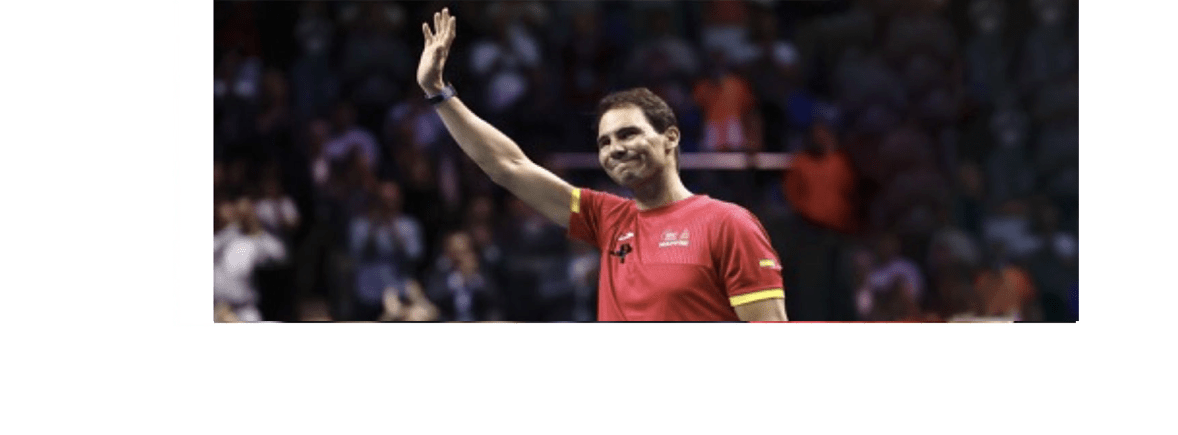
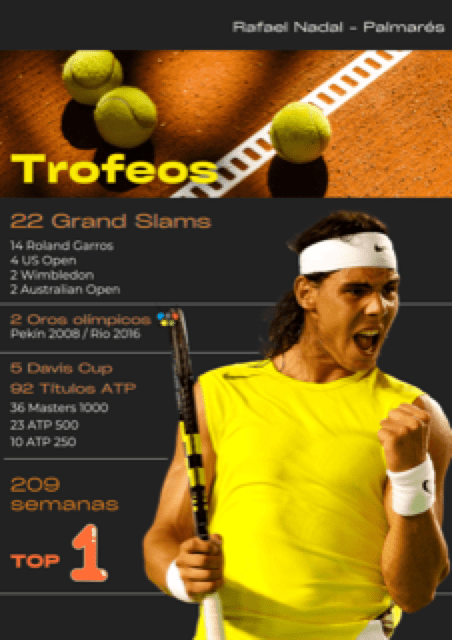
When the time comes for a top professional sportsman to say farewell, as happened with Rafael Nadal on 19 November 2024, a flood of praise, appreciation and statistics rolls in. And when we are speaking of an all-time great, as in this case, attention turns to his legacy.
Carlos Sánchez Blas is a sports journalist from Madrid with extensive experience in media such as DAZN, Marca, Onda Madrid, etc. For him there is no doubt that, above and beyond the titles he won, the unique and intangible mark that Nadal left was “his thrilling style of play. A player able to transfix anyone watching, whether on television or court-side – even people who did not think of themselves as tennis fans. This on top of his more tangible legacy of titles, Grand Slams, sustaining his level over so many years, and coming back from really serious injuries.”
These injuries were the greatest burden that the Manacor marvel had to bear. His aggressive style of play may have caused him to push his body to the limit too many times. In all, he suffered 24 injuries throughout his career, which meant him missing out on competitive tennis for more than 1100 days – cumulatively, the equivalent of about three years of missed matches. We will never know how much more Nadal could have achieved if his body had not taken such a battering.
Perhaps the ‘healthiest’ part of his body was his mind. So says Oscar Rincón, a sports journalist from La Sexta TV, specialising in tennis: “what always impressed me most about Nadal was his ability to focus solely on the next point. It didn’t matter if he’d just played a fantastic winner or an unforced error. He was able to reset his mind, clear his thoughts and start from scratch again on the next point. There has never been anyone like him in this regard.”
Nadal’s steely mind made up for any slight deficiencies in his game compared to the very uppermost players of his generation. Just ask his great rival and friend, Roger Federer. The duels they fought have become part of the history of sport. We are unlikely to see a rivalry on this scale again, studded with magical, epic and dramatic moments.
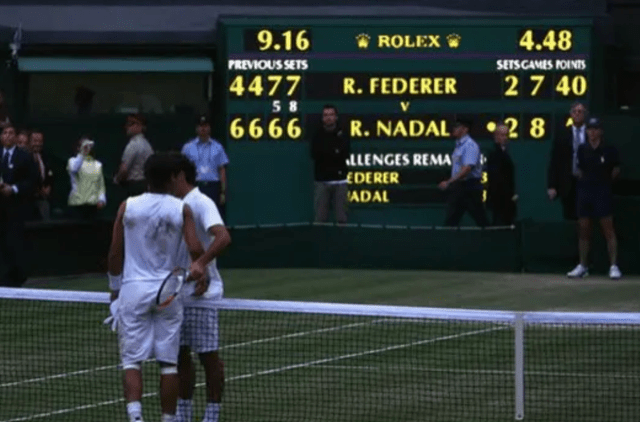
Nadal and Federer went head to head on 40 occasions, including nine Grand Slam finals. One of these, the Wimbledon final of 2008, is widely regarded as the greatest match in the history of tennis. After battling it out for 4 hours 48 minutes, the Spanish player managed to defeat his Swiss rival on the latter’s favourite court. And for all the quality of their sporting rivalry, what is even better, without doubt, is the friendship and respect they share both on and off the court.
Oscar Rincón rates such sportsmanship as the other great legacy that Nadal has left: “no one has ever seen Nadal throw his racket on the ground. Given the things that go on these days, I count that as something very special in his favour. He never looked for excuses in his rackets, his shoes, the wind conditions, nor even bad luck… He accepted what came, and just focused on the next point.”
Spain’s greatest ever sportsman

It was already a topic of debate before his retirement, but Rafael Nadal’s farewell prompted a widespread airing of the great question: are we saying adiós to the greatest Spanish sportsman ever seen? If we were to base our answer on the numerous surveys published in the media, there would barely be any debate necessary: a large majority of Spaniards would accord that honour to Nadal.
Our journalists also chip in their two penny’s worth on this question. Carlos Sánchez Blas, although considering it a difficult assessment to make, is quite clear: “there are certainly sportsman who have done as well as him in terms of effort and achievement, but not in such a high-profile sport. There may be some, like Pau Gasol, who come close to Nadal‘s achievements. But if I have to nail my colours to the mast, I would say that, yes, Nadal is top.”
For his part, Oscar Rincón, a keen tennis player himself, also thinks it comes down to Nadal’s personality: “without a doubt, he has been our most charismatic sportsman. That first image of him, with the long hair, sleeveless shirt and Capri shorts was a breath of fresh air for tennis. A groundbreaking image, which went with his demonstrative way of celebrating hard-fought points he won, but always with respect. In that, he has been peerless. On a personal level, I would say that he is the sportsman I have most admired. He has given us such amazing times… Those Sunday afternoons with us, his fans, playing every shot with him, sprinting to every corner of the court with him – I’ll always carry those memories in my heart.”
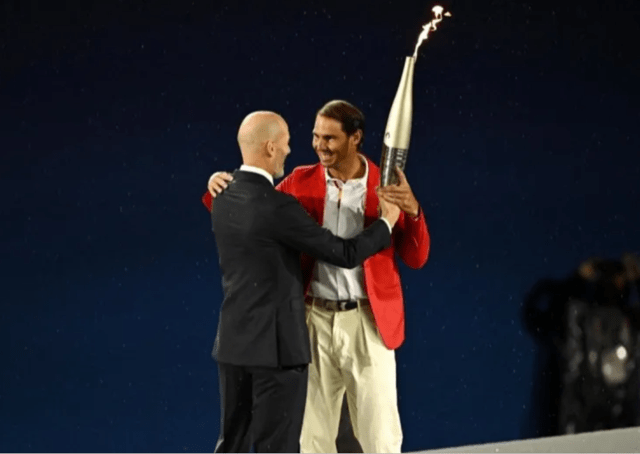
It’s not easy to say goodbye to a legend – least of all, this one. But in the case of Rafael Nadal, the final chapters of his professional story have been well scripted. Starting with his stellar appearance at the Paris Olympics opening ceremony in 2024. Not in his wildest dreams would he have expected to bear the torch in the final stage of its Olympic journey – with it being handed on to him, moreover, by his footballing idol, Zinedine Zidane, whose Real Madrid team Nadal has always supported. But Paris, the city that saw him win 14 times on the clay of Roland Garros, could not forget its champion.
His last game, on 19 November 2024 in Malaga, at ‘his’ Davis cup, taking on a Dutch player with the unpronounceable name of Van de Zandschulp, will always be remembered for the tears shed by thousands of fans in the stands and for the most heartfelt ovation ever seen on a tennis court.
“I go with the satisfaction of having left a sporting and personal legacy, because I know that the affection I receive all around the world, if it were only for what I have done on court, would not be the same,” he said. I couldn’t agree more. Thanks for everything, Rafa.

Translation by Robin Wallis.
 Bulletin of Advanced Spanish