
The second in a series of three articles on ‘the visual’ by BAS Editor Nathanial Gardner.
While most (if not all) visual scholars agree that, when studying photographs, it is key to focus on collections or series of images, it is not uncommon for different publications on visual studies to publish short pieces that allow a deep read into one specific photograph. This type of exercise can be useful because it allows you to focus on just one image profoundly. If you ever tackle a challenge like that, most of my advice regarding the reading of photographs from my previous article also applies. Perhaps most important when offering the read of a single photograph is to be sure that you have sufficient grounding in context, so that the reading can have the maximum level of relevance possible.
I will now offer a deep read of a documentary photo from a video/performance art project called “Re-enactments” by the Belgian artist Francis Alÿs – a long-term resident of Mexico. After being stationed in that country during his Belgian military service, and after graduating as an architect in his native country, Alÿs returned to Mexico where he began to establish himself as an international artist whose work has been exhibited across the globe. While he is based in Mexico, his work does not only take place there. He has worked in other countries such as Peru, Belgium, Iraq, Afghanistan, among others. His art often has broad themes such as play, conflict, or work.
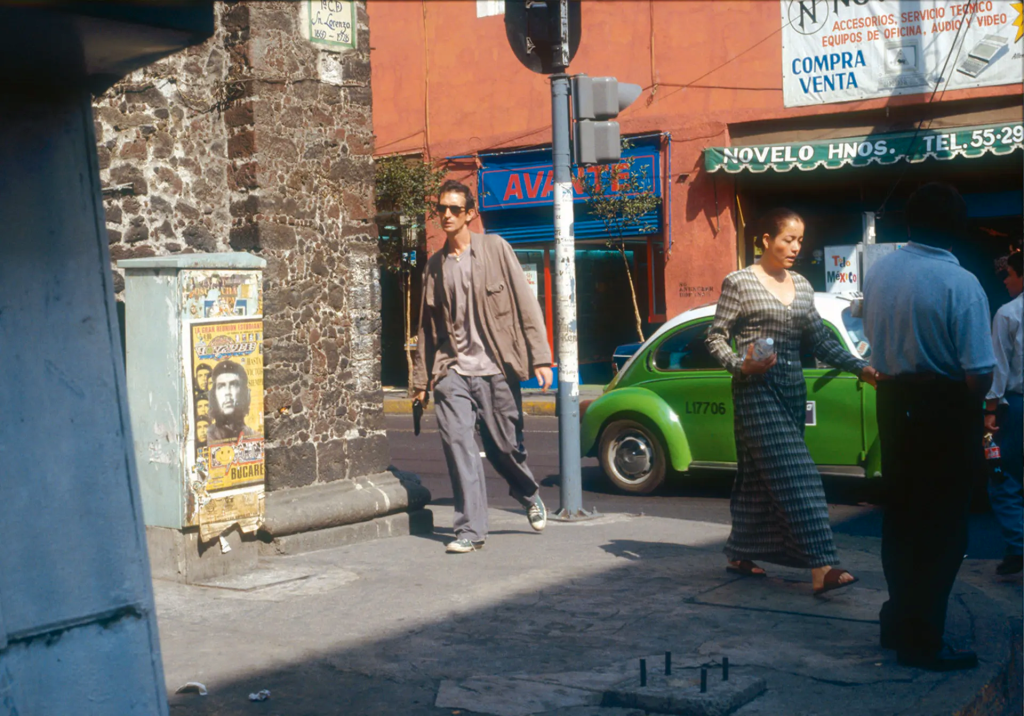
This image (which, for ease of reference, we reproduce twice again as you read through this article) belongs to one of his Mexican projects from the late 1990s and early 2000s in which the artist focused on individuals who walk across the city. This walking as art can take many forms, but the one thing this series of photographs has in common is that those who walk (himself or others with whom he collaborates) move across the historical district (centro histórico) in Mexico City. For example, he has taken a magnet on wheels for a walk across the city to see what type of detritus it will pick up. He hired someone to push a large block of ice along the streets of a city until there was nothing left of it. In another series of photographs, we observe visual evidence of many of the street sellers, ambulantes, who make their living via many forms of informal employment. One reading of this work can be as a criticism of the sub-employment that exists in the neo-liberal Mexico of that period (and still persists today).
The photograph featured here is from perhaps his most daring venture in the ambulantes series (which might explain why it is him who is pictured in the photograph). This specific example comes from a video of Francis Alÿs walking into a gun shop on Calle de La Palma (near the Zócalo) in Mexico City, buying a 9mm Beretta and then proceeding to walk with the loaded gun though the same area until he was stopped by the police. In a way that might only be possible in Mexico City, Alÿs then explained to the police that he was an artist and that the stroll with a loaded weapon was only part of an artistic performance. He was allowed to go free. Then, in an even odder twist of circumstances, the police agreed to take part in a “re-enactment” in which Alÿs undertook the same stroll with a replica pistol and the police pretended to arrest him, as they did in his original walk.
There are many ways of reading this photograph. You can see it as a criticism of the normalization of violence in Latin America. It can be a discussion on danger (as both the act and the “re-act” subjected the artist to an elevated level of risk during his performance). Given the police interaction, the theme of law and order can be read into the image.
However, as we look at the single photograph, we may want to ask ourselves, why has the artist chosen this photograph to represent this artistic performance? Without an explanation from the artist, it is difficult to know fully, but a discussion of the details of the image helps us to identify meaning.
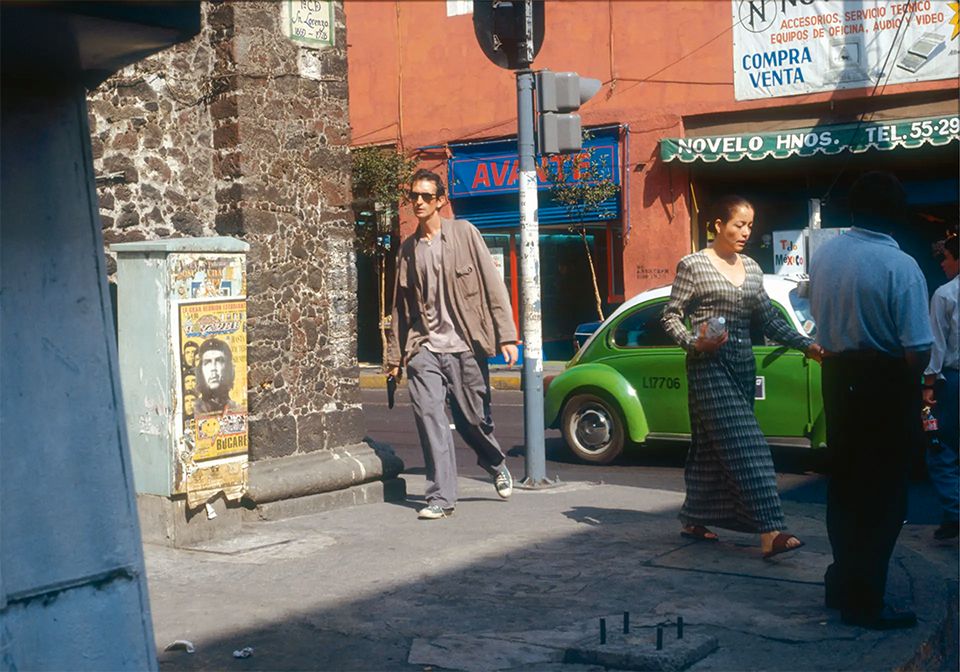
As we focus on the information within the photograph, this evidences a meditation on violence as well as on Mexico and Latin America themselves. The photograph was taken in the centro histórico, not far from the Tepito neighbourhood, which is notorious for its levels of crime and violence (amplifying the level of danger as well for Alÿs, who is undertaking this risky act in the name of art). He is casually dressed – looking different from his “professional tourist” photograph (below) that he took just adjacent to the Zócalo (main square) where other professionals (such as plumbers and carpenters) wait for work in another artistic performance that he staged around that same time.
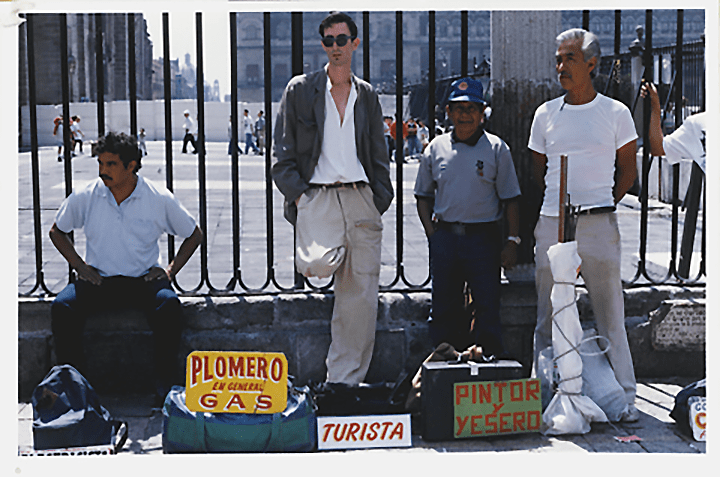
This difference between tourist and artist is important as it shows him making an effort to integrate into Mexican life and to engage with its social problems: Mexico is now his home, so its problems are also his. The fact that Alÿs carries the gun in broad daylight down a busy street in central Mexico City is a clear comment on the presence of violence even in the heart of the Mexican capital.
Go back to our main ‘re-enactment’ photograph and scan the detail from left to right. You will notice that it goes from the non-specific in Latin America to the specific. On the bottom left-hand corner (at relatively the same level of the gun) is a poster of Che Guevara. Associated with youth, rebellion and violence, this is a clear reminder of Latin America, its revolutionaries, and its history of radical politics.
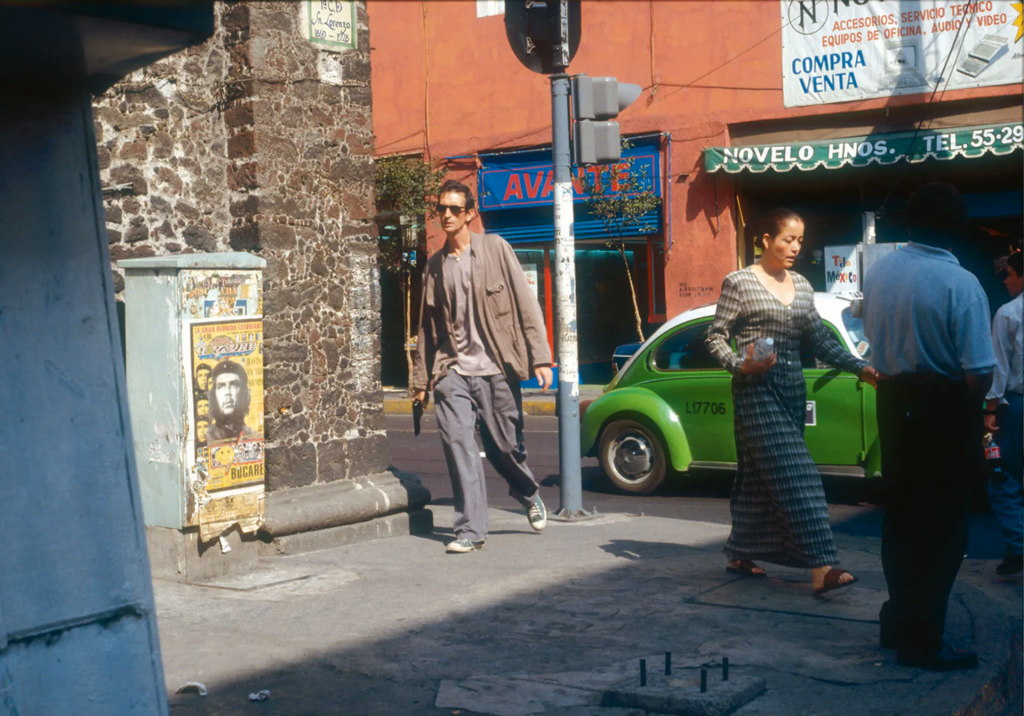
The image then moves to the more specific. The photograph makes overt and subtle reference to Mexico. The tell-tale architecture of the Capilla de San Lorenzo is made from the same colonial material cannibalized from Aztec structures to create both colonial and mestizo buildings (just as the Conquest gave rise to modern Mexico’s predominantly mixed race population).
Another less subtle reference to the Mexico City location is the taxi cab. Though still recognizable in monochrome representations, the colour images help the viewer to recognize the scene as one from the capital because the green Volkswagen Beetle was at that time the most common taxi cab in the city.
Finally, just above the car is a public telephone on which you can see the TelMex slogan Todo México colourfully listed on the phone book. A standard style of the phone booths from that period, the image helps to identify the location as Mexican. If there were any doubt regarding the location of the image, this detail clarifies it.
So, a simple visual reading (because there are others) could be to show how the image offers a line of visual information that starts with Che Guevara, moves to the chapel, then the gun, to the taxi and finally to the phone book with its Todo México message on the other side of the image. It is a linear progression. It offers a spectrum with a broad symbol of Latin America at one end and of Mexico at the other, with the instrument of violence (a man and his gun) in the middle. The photograph suggests violence, and comments that Mexico is high on the spectrum of violence in Latin America.
As you can see, a more profound reading of an image is useful as it helps you to think deeply about what it might mean. To do so successfully, you need to take time with the image, consider its contents and composition, and to contemplate its context and creator(s).
Try it, and see what you discover.
Links to photograph:
https://www.moma.org/collection/works/130829
https://www.davidzwirner.com/artworks/francis-alys-re-enactments-c6003
 Bulletin of Advanced Spanish