
BAS editors Nathanial Gardner and Robin Wallis take to their sofas to watch respectively Pedro Páramo and Cien años de soledad on the small screen.
In recent weeks Netflix has streamed adaptations of the classic Latin American novels Pedro Páramo (1955) by Juan Rulfo and Cien Años de Soledad (1967) by Gabriel García Márquez. The HBO-on-demand serialization of Laura Esquivel’s Como agua para chocolate (1989) has also come out at the same time.
In many ways this is an important win for these three novels, all of which were written in Mexico. (We hear some readers saying “But Gabriel García Márquez is Colombian!” Indeed, he is, but he was living in Mexico City when writing this, his most famous novel, and for much of his adult life.)

However, viewers will be struck by the differences between the visual representations of these well-known books. From the outset Laura Esquivel envisioned her novel as a film – not surprisingly, given that she had studied scriptwriting and was married to the filmmaker Alfonso Arau when the novel was written. By contrast, García Márquez and Juan Rulfo saw their novels as literature that consciously differentiated itself from cinema. In fact, García Márquez described his classic novel as an experiment in what the printed word could do that cinema could not.
When you reflect on what was possible in cinema in the 1950s and 1960s, it is of no surprise that these tales so heavily laden with Magic Realism were seen as a form of narrative best played out in the mind’s eye. Both Pedro Páramo and Cien años de soledad have fantastic episodes that would have arguably suffered visually when recreated in the cinema of those days. In this sense (and in a multitude of others) this is one of the great successes of those novels. They could (and can) tell you a story in a way that allows your mind to leave normal reality and travel deep into the possibilities of imagination.
However, as the decades have passed, film’s possibilities have grown exponentially. What was previously the preserve of the imagination is now ever more possible to be represented on the screen with ever more visual enticement.
In the case of Pedro Páramo, the Netflix adaptation strives to be faithful to the original text. The town where it is set, Comala, is believably isolated and barren. Rulfo’s only novel is one of subtle magic, and this magic is equally subtle in the film. Ghostly figures appear with vivid realism. Unexplained events are left unexplained. The past and the present are interwoven just as Rulfo had positioned them in his original.
If the novel Pedro Páramo was a successful literary experiment in what you could call Latin American literary minimalism, in the film this translates into almost no outside intrusion, no memorable music score for the film, and very little hand-holding in terms of how the narrative carries the viewer. As someone who knows the novel well, I personally found this a positive quality of the film – though I did wonder how that experience might play out for a viewer who was stumbling across Rulfo for the first time.
The one aspect of Pedro Páramo that I found notably different as a literary experience was that of the brother and sister living in an incestuous relationship. In the novel I found this topic very nuanced, and difficult for more casual or novice readers to detect or understand. In the film, this element is one that is easy to absorb precisely because of its explicit nature. Reviews of Cien años de soledad also underline the explicit nature of the Netflix adaptation. Visual representations tend to do this, to make the verbally demure visually revealing.
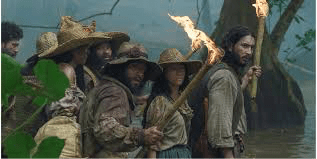
Minimalism is not a term that applies to Cien años de soledad, a novel whose sweep and ambition has been compared to that of the Bible, with its vast array of characters and trajectory from a newly created world to an apocalyptic denouement. The vast sums invested in the Netflix production, which is wholly filmed in Colombia, have ensured a sumptuous visual spectacle.
The production’s faithful adherence to the novel’s storyline has been praised by reviewers. Both on screen and in print, García Márquez’s characters live out their time at the mercy of recurring forces embedded both in human nature and the natural environment.

Yet, inevitably, the transition to the visual medium entails a change in ethos. Principally, García Márquez’s trademark narrative flow, with long paragraphs full of incident that typically build to a pithy line of direct speech to crown, deflate or ironise what has gone before, is replaced by more methodical story-telling style on Netflix. The novel is a notoriously disorientating procession of characters through the generations, with names that recur confusingly over the years. The culture, the landscape and the genealogy determine events and outcomes, rather than individual will power.
On the screen, it becomes easier to identify the storylines of individual characters. Their personal stories stand out more clearly, and become increasingly gripping as the series proceeds. However, viewers who know the novel may miss its capacity for surprise and humour. The novel is famous for its magical realism: the TV adaptation majors on the realism, but is more restrained when it comes to magic.
For all the excellence of the Netflix adaptation, viewers unfamiliar with the novel may yet be left wondering why it is so highly rated by literary folk. That said, there are eight more episodes yet to be released: we shall reassess in these pages once we have seen the completed work.
All in all, it is a boon to Latin American studies to have these grand classics so widely available now to a multitude of new viewers. Given the initial success of these productions, it will be no surprise if others soon follow.
 Bulletin of Advanced Spanish