Dr Celia Szusterman examines why El Salvador’s approach is not the solution for the spike in violent crime in Ecuador.
Crime and violence have long been a top concern for families across Latin America. The region accounts for nearly half of the world’s intentional homicide victims, although it has eight percent of the global population. If governments in the region were able to prioritize more effective crime-fighting strategies, these would not only enhance public safety but also improve the region’s economic potential.
In a recent report the IMF estimated the average macroeconomic impact and cost of crime in the region at between 1.5 to 2.0 percentage points of GDP. Taking into account the high rates of poverty, and the fact that Latin American societies are the most unequal in the globe, it is clear that beyond the horrific costs of loss of life, violence imposes an economic cost that countries cannot afford.
While the northern triangle countries of Central America (El Salvador, Honduras and Guatemala) have consistently shown the worst violence-related statistics in the region, in the last couple of years Ecuador has climbed up the crime-related tables. Yet as recently as 2018 Ecuador was considered to be one of the most peaceful countries in Latin America, an oasis enclosed in the south by the political instability and Shining-Path violence in Peru, and in the north by the decades-old Colombian armed conflict between government and mostly FARC guerrillas.
The increase in violence in Ecuador coincided with the arrival of drugs, which in turn was closely correlated to the implementation of Plan Colombia, an anti-drugs and anti-FARC strategy first conceived in 1999. The heavy security operations financed by the US forced the Colombian narco-guerrillas to seek alternative routes to store and ship cocaine to the US and Europe.
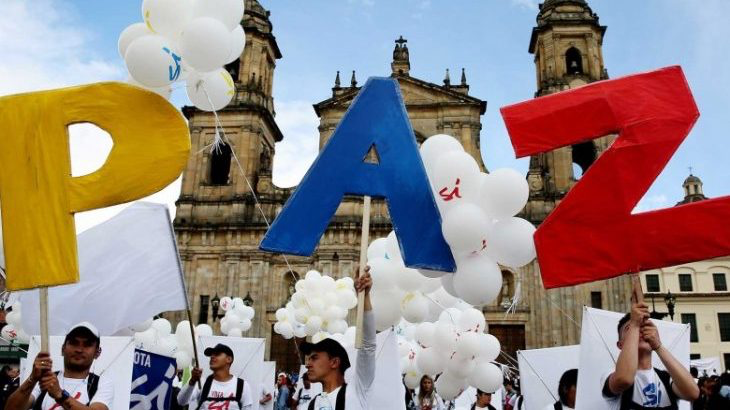
In 2016 Plan Colombia was replaced by the Peace Accords signed between the government, paramilitary groups and most of the FARC. Although not all guerrillas-turned-narcotraffickers joined the peace negotiations, a pivotal incentive for the FARC to abandon the armed struggle was the possibility of becoming a political party and joining civil life in Colombia. This is key to understanding why negotiations were possible in Colombia but cannot happen in Ecuador, where the serious criminal organisations are money-driven foreign cartels interested solely in financial gain, and not in becoming a political force in Ecuadorean society.
Violent prison riots in 2019 brought to light for the first time the Balkan mafia’s control of Ecuadorean prisons. They also revealed the presence of transnational cartels in the country, specifically the Mexican Sinaloa and Jalisco Nueva Generación. After President Guillermo Lasso’s failure to control prisons, and his early departure from the office, Daniel Noboa was elected to complete his term until 2025.
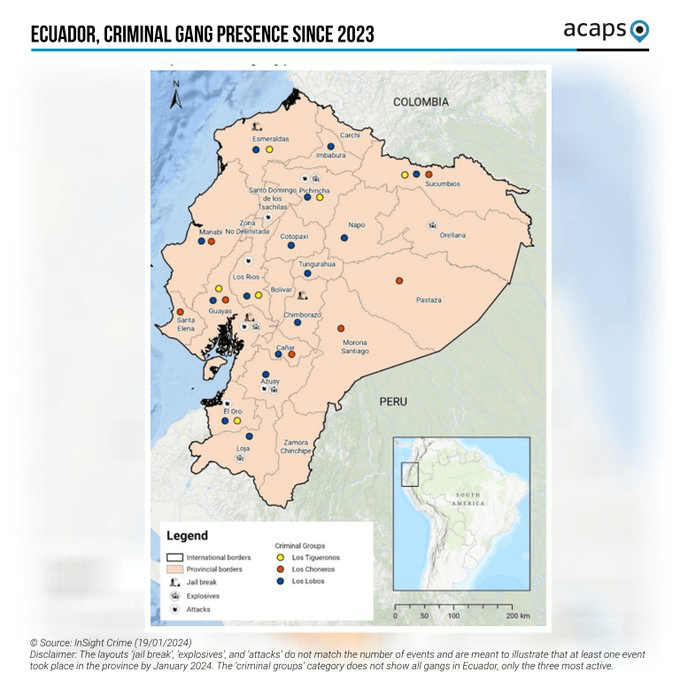
In December 2023 the Attorney General launched Plan Metastasis, an anti-corruption plan aimed at revealing and dismantling in the judiciary the extensive network of corrupt government officials, judges, police officers and prison personnel. The ensuing prison riots of 8th January 2024 were a direct result of Metastasis, which included transferring the imprisoned leaders of drug cartels to maximum security establishments. The depth and extent of corruption was revealed when ‘alias Fico’, head of the powerful Choneros gang, disappeared from his cell. This was the spark for a series of violent events focused mainly on the city of Guayaquil. As a result, President Noboa issued Decree 111 declaring a state of internal war, sending the military onto the streets and into the prisons to restore order, imposing a curfew and classifying twenty-two different gangs as ‘terrorists’.
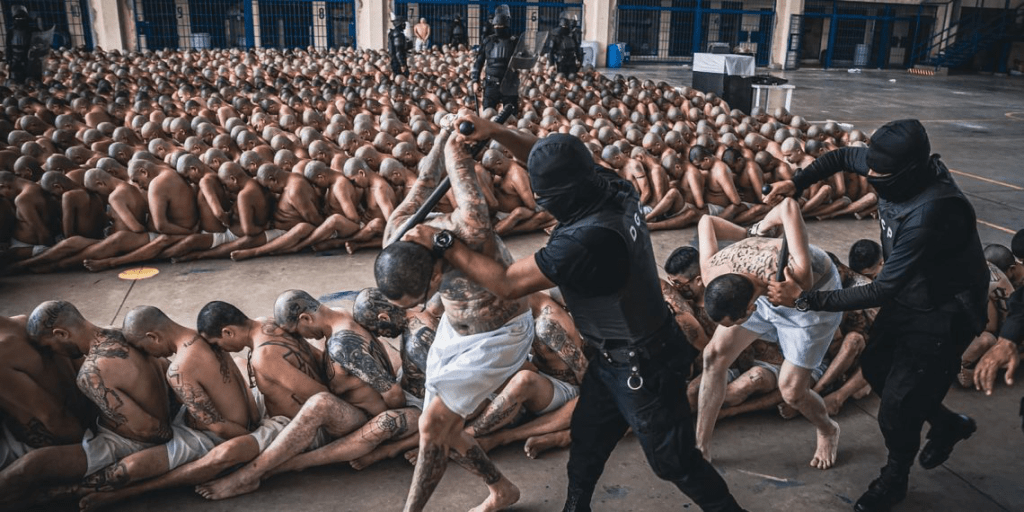
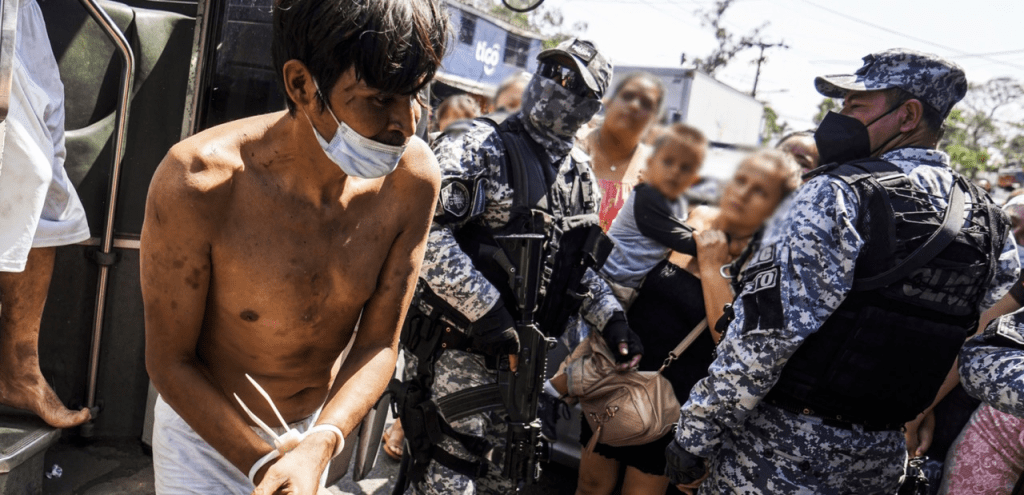
Notwithstanding these measures, peace has not been restored to the streets of Guayaquil. The government published photographs of rows of half-naked, crouching detainees, reminiscent of those posted by the Salvadoran government to symbolise its ‘Plan Bukele’. The latter, named after El Salvador’s President Nayib Bukele, relies on the suspension of civil rights and mass incarceration – a ‘state of exception’ that has now become normal.
These images were hailed internationally as proof of Bukele’s determination to end gang violence. Politicians across Latin America began to cite what is known as ‘punitive’ or ‘penal’ populism as a model to be copied, disregarding the particular Salvadoran context and the consequences of the dual policies of mass incarceration and militarisation of security. However, can criminality in El Salvador and Ecuador be compared meaningfully? Is the so called ‘Bukele Model’ one to be emulated by other countries in the region, as so many politicians (and the public) favour? Do the policies implemented by Bukele reflect an enlightened security model that will deliver peace and security in the long term?
In 2015 El Salvador had one of the highest murder rates in the world, outside war-zones. Nowadays, the situation has reversed: Ecuador has seen its homicide rate climb steeply, while El Salvador’s trend in homicides continued its downward trajectory. The 2023 UNODC report on global homicide rates put El Salvador at 7.8 homicides per 100,000 inhabitants, while in Ecuador the rate was 27 per 100,000. Mexico and Colombia scored 26 and 25 respectively. A rate of more than 10 per 100,000 is considered a violence “epidemic” by UN agencies.
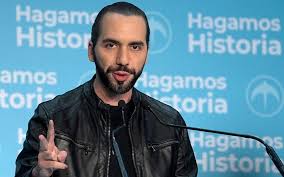
The claim by President Bukele that the dramatic fall in homicide rates is evidence of the success of his Territorial Control Plan has to be put in context. Homicides had been on a downward trajectory in El Salvador since 2015, and continued to fall in 2019 when Bukele became president. Then, during one weekend at the end of March 2022, there were 86 homicides. On the Monday Bukele declared a state of exception, initially for three months but which has been in place continuously since then.
There is ample evidence that Bukele’s representatives had been meeting with imprisoned gang leaders in spite of the President repeatedly announcing that he would not “negotiate with terrorists”. One such leader, “el Crook”, at the time serving a life sentence, mysteriously turned up in Mexico, from where he was deported to the US to await trial.
Bukele’s stated aim, on launching his Plan, was that 75,000 gang members and their associates would be rounded up and imprisoned. His administration would build the largest prison in the Americas, suspend all procedural guarantees, reduce food rations, and prohibit all visits, including of lawyers. As a result of these draconian measures, El Salvador now has the highest imprisonment rates in the world. Just to give one example, with a population of six million El Salvador is estimated to have almost 100,000 people incarcerated, while England and Wales, with ten times the population of the country has a prison population of 86,000.
More than eighty per cent of those arrested in El Salvador are still awaiting trial. With little regard for the rule of law, let alone human rights, Bukele has declared they will never be let out. Moreover, most victims of police and army raids were poor young men. This not only destroys their lives, it has a catastrophic impact on their families and communities and erodes the foundations of democracy. As someone once asked, will ‘iron fist’ policies result in a society worth living in?
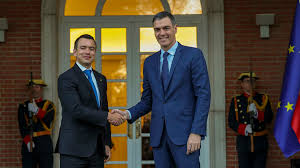
In Madrid recently, President Noboa distanced himself from the Bukele security policies: “we want to emphasise jobs, education and development, not just grenades and machine guns. We want to offer opportunities to people who had nothing and ended up in those narco-terrorist groups” (El País, 17th May 2024). Many studies have concluded that there is no correlation between incarceration rates and crime rates globally. People who mock those who defend the rights of prisoners as human beings tend to say: “what about the human rights of victims?” Clearly victims have been deprived of the first human right, their right to life. The Universal Declaration of Human Rights in its articles 3 and 5 states that everyone has the right to life, liberty and security, but it also reminds us that no one shall be subjected to torture or cruel or degrading treatment or punishment, and that everyone has the right to justice and a fair trial.
The demand for citizen security at times challenges the future of democracy. Politicians eager for quick solutions resort to militarisation in order to provide citizens with a secure context in which to live their lives. When the State fails to deliver security, opinion polls throughout Latin America have revealed people’s willingness to cast off the rule of law and values of democracy. As Mexico has shown, militarisation of internal security does not offer an exit strategy: on the contrary, it undermines the institutions of law enforcement.
In El Salvador, Ecuador, Mexico, Colombia, Nicaragua, Venezuela and Cuba, people aspire for more peaceful and equitable lives. The struggle continues for just and decent societies in which state institutions do not humiliate their citizens.
 Bulletin of Advanced Spanish