Magaly Santos takes a grassroots look at the Mexican ecosystem.
From sea-level rise to drought, wildfires, and flooding, climate change’s effects are increasing worldwide. With a unique geography and many rural populations, Mexico—a place I hold dear to my heart—is especially vulnerable.
As a part of University of California (UC) Berkeley’s Latinxs and the Environment Initiative, I had the opportunity to travel to Mexico City and Oaxaca for two weeks in August 2024 to learn about agriculture, water management, and how rural communities adapt to climate change and preserve their cultural heritage. Conociendo Nuestra Cultura (Knowing Our Culture) is a bi-national program supported by UC AlianzaMX, an initiative that connects students from across all ten UC campuses with Mexico by providing funding for research collaboration, academic mobility, and other engagement activities. In the program’s first phase, I joined nine other participants to attend weekly lectures by researchers, government officials and professors from UC Berkeley and UC Davis in June and July.
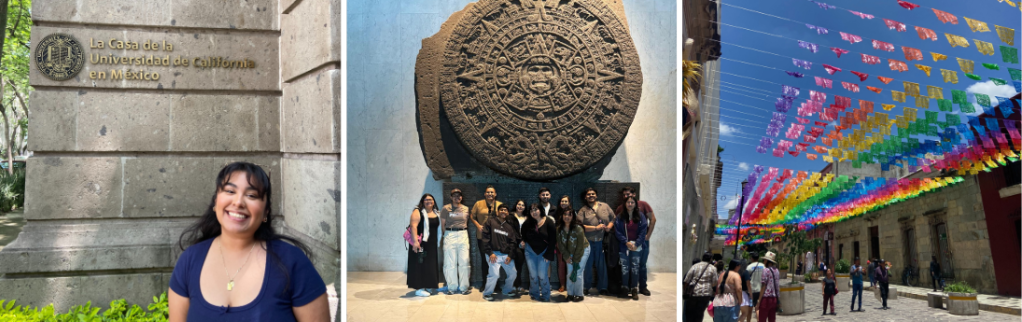
Left: Magaly Santos at the University of California House in Mexico City. Center: Program participants at the National Museum of Anthropology in Mexico City. Right: A view of the Oaxaca City Center.
At the beginning of August, we traveled to Mexico City, where we heard from Dr. Luis Zambrano of the National Autonomous University of Mexico (UNAM) about analyzing Mexico City’s water crisis from an urban ecosystem perspective. We learned that groundwater over-pumping and continuous urbanization are causing the city to sink. Aquifers and reservoirs can’t recharge at the same rate of extraction, and many areas are experiencing flooding and a lack of drinking water.
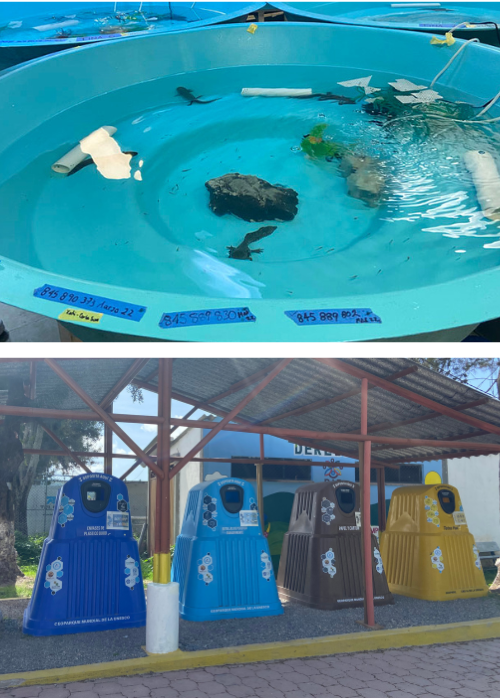
Top: Dr. Zambrano’s axolotl lab at UNAM
Bottom: Community member zero waste educational initiative bins in Santa María Chachoapan
One of the biggest challenges to Mexico City’s water crisis is the lack of seamless collaboration between government bodies, water agencies, and educational institutions. Addressing this issue requires recognizing the complexity of water management in a rapidly growing urban environment and fostering partnerships that prioritize shared responsibility. While Mexico has made notable strides in combating environmental challenges through climate policies and water initiatives, the unique geographical and infrastructural challenges of Mexico City, such as subsidence due to groundwater extraction, underscore the need for innovative and united approaches. Collaboration between stakeholders, informed by science and community input, is essential to ensure sustainable solutions for the city’s future.
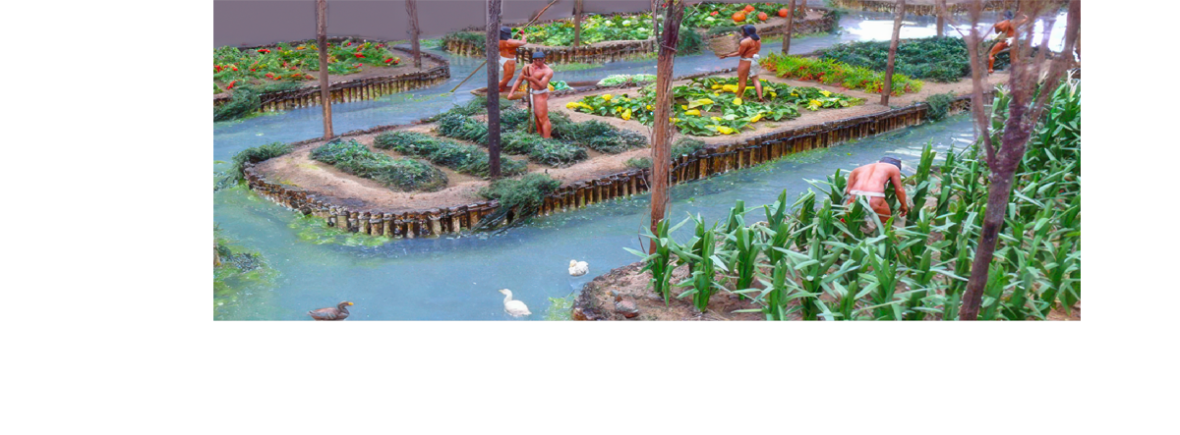
An example of these challenges is Xochimilco, a canal farming community deeply affected by water scarcity and flooding. Through the Chinampa Shelter Project, “Refugio Chinampa,” Dr. Zambrano has worked alongside communities in Xochimilco to conserve chinampas and restore the ecosystem of the axolotl, a critically endangered paedomorphic salamander. Chinampas are wetland farming systems, consisting of small islands traditionally used for agriculture and linked together by networks of canals. The chinampas assist in recharging underground aquifers, regulate local and regional water flow, serve as a home for the axolotl, and hold cultural significance to the communities of Xochimilco. These efforts contribute to the fight against climate change by building more environmentally and socially sound communities, restoring the ecosystem in Xochimilco, and alleviating the water crisis in Mexico City.
We also visited the Geoparque Mundial Mixteca Alta, a geopark consisting of nine municipalities within the Mixteca Alta region of the state of Oaxaca. There, we were fortunate to learn from and interact with three rural communities: Santa María Chachoápam, Santa María Suchixtlán, and San Bartolo Soyaltepec. We heard about Santa María Chachoapan’s Zero Waste educational initiative, and how community members built dams and reservoirs to catch rainwater during periods of severe drought.
This geopark – part of the UNESCO Global Geopark network – is dedicated to leveraging its geological heritage, along with the region’s natural and cultural heritage, to promote awareness and understanding of critical societal challenges, such as climate change mitigation. Integrated into the educational system throughout the municipalities, the Zero Waste initiative provides environmental education to all ages – children, youth, and adults.
One of the community managers we spoke with mentioned how children are essential to the propagation of knowledge throughout this initiative. Children grow enthusiastic about participating in the process of recycling and organizing waste to ensure best waste management practices. The manager explained how the children themselves became educators by encouraging their parents to participate in the efforts. The initiative itself stemmed from Geography Master’s student Selene Eridani’s research thesis on the “Proposal for a municipal program for the prevention and comprehensive management of urban solid waste in Santo Domingo Yanhuitlán.” This initiative not only fosters environmental awareness and action, but also exemplifies how education can empower communities to address environmental challenges collectively, bridging academic research with practical, locally-driven solutions.
We also met farmers who are adapting by using drip irrigation and crop rotation to preserve water. Most farmers we encountered purchase hybrid seeds from large corporations or the government because they are more affordable than native criollo seeds. But seeds from the patented hybrid maize (corn) don’t grow if replanted, so farmers remain reliant on the corporations. They have also noticed that hybrid seeds do not grow as well in the varying terrains and temperatures of this region in Oaxaca, with little room for the ability to adapt to changes in climate or the land. One farmer who used native criollo seeds selected the maize with the best characteristics and was able to preserve seeds for the next season. Although most farmers rely on hybrid seeds, they aim to move toward using more criollo seeds, to have more autonomy over their crops.
At UNAM-Oaxaca we heard about maize diversity in Mexico from agroecologist and geographer Dr. Quetzalcóatl Orozco. Orozco told us about the evolution of maize’s ancestor, Teocintle, into what we think of as corn today, and how indigenous communities around Mexico continue to conserve native corn.
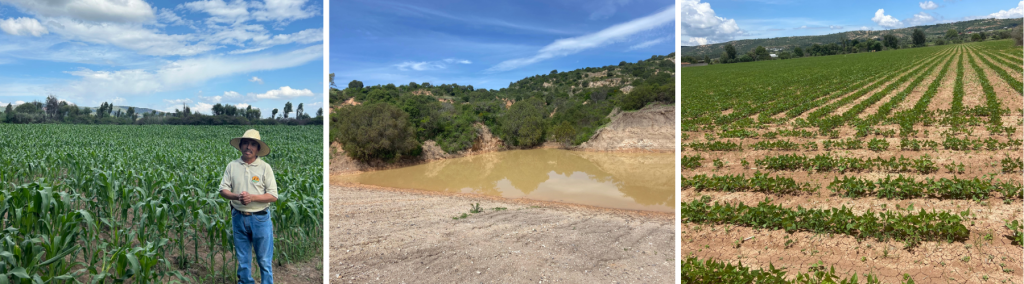
Left: Farmer in Santa María Suchixtlán showing the growth of a native criollo field of corn (Image courtesy of Martin Mera Cervantes). Center: Dam built by community members in Santa Maria Chachoapan to capture rainwater. Right: Field of black beans in San Andrés Sinaxtla.
Maize, as we know it today, is the result of the domestication of teocintle, a wild Mexican grass, through centuries of human intervention and selective breeding. This process, which likely began over 9,000 years ago in the Central Balsas River Valley, Mexico, represents one of the earliest and most significant agricultural innovations in human history. The transformation of the teocintle into maize not only provided a reliable food source, but laid the foundation for the rise of pre-Hispanic civilizations across the Americas. The annual Mexican plant remains a significant part of the region’s agricultural systems, contributing to traditional cuisines and cultural identity. Today, maize is one of the most widely diverse, cultivated, and consumed staple crops, with over 59 native breeds and countless varieties. The immense cultural significance it holds for communities in Mexico and beyond is apparent through the conservation of maize by indigenous communities, and in governmental efforts to ban GMO variants of the crop.
Although I previously visited Mexico to see family in Jalisco, I had not previously visited Mexico City or Oaxaca. As a Mexican-American, first-generation, low-income student in academia, I never imagined I would have the chance to study abroad. Even more so, I never expected that I’d be able to study in a country so special to me—the land of my parents, grandparents, and ancestors. This experience allowed me to further connect my research on groundwater and agriculture to my identity, and to identify ways in which I can contribute to research and movements abroad.
Magaly Santos is a fourth-year UC Berkeley student majoring in Environmental Economics and Policy with minors in Food Systems and Geospatial Information Science and Technology. She has been a research fellow for the Latinx and the Environment Research Fellowship and is a communications assistant for UCB’s Rausser College.
This is an extended version of an article first published in the Fall 2024 edition of Breakthroughs, the magazine of Rausser College of Natural Resources at the University of California, Berkeley.
 Bulletin of Advanced Spanish