BAS editor William Chislett

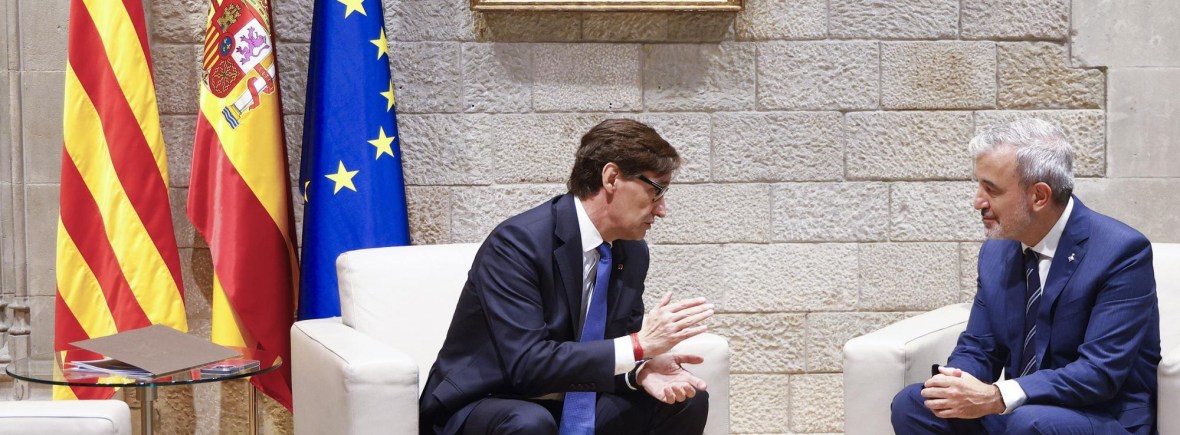
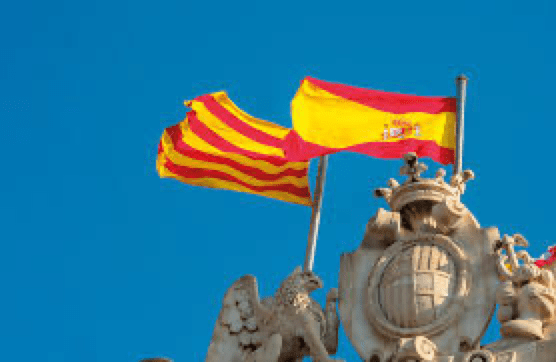
Symbols are important and can often say much more than words. Soon after the new Catalan administration took office, the first one led by unionists in 14 years, it restored the Spanish flag to the Generalitat palace, the ancient heart of the region’s government. Salvador Illa, the new Socialist premier, greeted King Felipe VI when he visited Barcelona.
Pere Aragonès, the previous Catalan premier, not only did not display the Spanish flag along with the Catalan flag, contravening the law, but also avoided having to formally greet the King by not attending the monarch’s official events. Illa, however, did not display the Spanish flag in the ceremony when he took over in August from Aragonès, leader of the separatist Republican Left of Catalonia (Esquerra Republicana de Catalunya, ERC) whose support was needed to form a government and so avert a fresh election. ERC also supports the Socialist-led central government in Madrid.
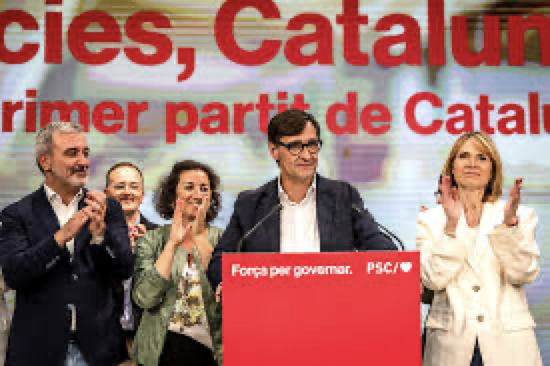
The Socialists won the most seats and the most votes in May’s snap election (42 of the 135 seats, nine more than in 2021, and 28% of the vote), but far from the 68 needed to govern on their own (see Figure 1). Together for Catalonia (JxCat) and the ERC, the two main separatist parties which are at loggerheads, obtained 35 and 20 seats, respectively, and between them 35.3% of the vote, also not enough to govern. The votes for pro-independence parties dropped from just over 2 million in 2017 to 1.3 million.
The unionist political right did well; the Popular Party won 15 seats on 11% of the vote (three and 3.8%, respectively, in 2021, its worst-ever results), while the hard-right VOX held its 11 seats.
Figure 1. Catalan elections, 2024 and 2021 (seats, votes, % of votes)
| 2024 | 2021 | |||||
| Seats | Votes | % of votes | Seats | Votes | % of votes | |
| Catalan Socialists | 42 | 827,959 | 28.0 | 33 | 654,766 | 22.7 |
| Together for Catalonia | 35 | 674,896 | 21.6 | 32 | 570,539 | 19.8 |
| Republican Left of Catalonia | 20 | 427,135 | 13.7 | 33 | 605,581 | 20.1 |
| Popular Party | 15 | 342,584 | 11.0 | 3 | 109,453 | 3.8 |
| VOX | 11 | 248,554 | 7.9 | 11 | 218,121 | 7.6 |
| Comuns-Sumar | 6 | 181,795 | 5.8 | 8 | 195,345 | 6.8 |
| Popular Unity Candidacy | 4 | 127,850 | 4.1 | 9 | 189,924 | 6.6 |
| Catalan Alliance | 2 | 118,302 | 3.8 | – | – | – |
| Citizens | 0 | 22,481 | 0.7 | 6 | 158,606 | 5.5 |
| Voter turnout (%) | 57.9 | 57.9 | 57.9 | 51.2 | 51.2 | 51.2 |
Source: Catalan government.
ERC agreed, after almost three months of negotiations, to back Illa, but at the price of a controversial ‘singular’ financing system for the region. In contrast to the pragmatic ERC, the maximalist JxCat is still led by the former premier Carles Puigdemont, who called the unconstitutional 2017 referendum on independence and remains in self-imposed exile in Belgium.

Puigdemont briefly reappeared in Barcelona in August 2024, despite a pending warrant for his arrest. On the day of Illa’s investiture, and flanked by Josep Rull, the JxCat president of the Catalan parliament and the second highest authority in the region, Puigdemont addressed a throng of supporters before returning to Belgium, evading arrest and making a mockery of the massive police manhunt for him.
At the national level, after the inconclusive general election in July 2023, the Socialists were only able to stay in power after granting an amnesty for some 400 activists facing charges for their involvement in the 2017 secession referendum. Puigdemont has benefited from the amnesty law as regards holding the referendum, but the Supreme Court ruled that his alleged misuse of public funds was not covered by that law.
The opaque financing pact, to be fleshed out and formalised in 2025 (it is very short on technical details), is the central government’s second major concession to the separatists in order to remain in power. The deal would see Catalonia move towards becoming autonomous in collecting and managing all the taxes levied by the state, through its own Tax Agency. This means exiting the common regime of financing for all of Spain’s 17 regions except the Basque Country and Navarre, which have their own conciertos económicos, similar to that agreed for Catalonia. These two regions, for historical reasons, collect taxes and make a contribution to the state (known as the cupo) for the services provided. Most of the taxes raised in the other 15 regions go directly to the central government and are then redistributed.
Critics on the political right and some regional Socialist leaders say the deal clashes with the system of ‘solidarity’, whereby poorer regions receive a portion of the revenues of the more affluent regions such as Catalonia, one of the richest (20% of Spain’s GDP). However, it appears Catalonia will continue to contribute a ‘solidarity’ quota to other regions.
Ángel de la Fuente, the Director of the respected Fedea research institute, claimed the deal would substantially reduce Catalonia’s contribution to the common fund. Based on 2022 data, he said it could see Catalonia increasing its tax revenue by around €30 billion, to the detriment of the state.
The text of the pact says Catalonia has suffered ‘sustained under-financing’, but the latest figures do not bear this out (see Figure 2). The region received slightly more than the average financing per adjusted inhabitant in 2022 and just above the average for the 15 regions. Valencia and Murcia, for example, are much worse off than Catalonia.
Figure 2. Financing of the regions per adjusted inhabitant (1), 2011 and 2022 (€ per person)
| 2011 | 2022 | % change 2022/2011 | |
| La Rioja | 2,634 | 3,954 | 50.1 |
| Cantabria | 2,615 | 3,944 | 50.8 |
| Balearic Islands | 2,260 | 3,877 | 71.5 |
| Extremadura | 2,411 | 3,809 | 57.9 |
| Canary Islands | 2,100 | 3,696 | 76.0 |
| Castile & León | 2,397 | 3,573 | 49.0 |
| Aragón | 2,363 | 3,529 | 49.3 |
| Asturias | 2,385 | 3,484 | 46.0 |
| Galicia | 2,325 | 3,448 | 48.3 |
| Catalonia | 2,187 | 3,396 | 55.3 |
| Average | 2,196 | 3,365 | 53.2 |
| Madrid | 2,201 | 3,364 | 52.8 |
| Castile-La Mancha | 2,158 | 3,193 | 47.9 |
| Andalusia | 2,105 | 3,182 | 51.2 |
| Valencia | 2,030 | 3,089 | 52.2 |
| Murcia | 2,079 | 3,056 | 47.0 |
(1) Population weighted by a region’s needs using criteria such as the elderly population and dispersion. Source: FEDEA, Ángel de la Fuente.
Successive governments have talked of reforming the financing system for years. Many agree it needs to change, but fear opening a Pandora’s Box of competing demands. Starting a reform of the system through an agreement with one region is not the most appropriate way. The PP, which controls 12 of the 17 regions and opposes the pact with Catalonia, is so far showing little readiness to negotiate a new system.

Artur Mas, a former Catalan premier (2010-16), sought a similar fiscal pact with the PP government of Mariano Rajoy in 2012, which was rejected because he said all regions needed to be involved. That rejection was one factor behind the procés. It was followed by a non-binding referendum on independence in 2014 (just over 2 million people out of 5.4 million eligible voters took part and 80% backed independence) and the 2017 referendum and declaration of independence.
The financing agreement also touches on other issues such as the teaching of Catalan in state schools. The central government has yet to respond to the previous Catalan government’s refusal to implement the 2022 ruling of the High Court of Justice of Catalonia requiring 25% of classes to be taught in Castilian Spanish, and not just in Catalan.
The disruptive and divisive Catalan independence movement has lost momentum and support, epitomized by the formation of the non-secessionist government. According to the latest survey, published after May’s election in the region, 40% are in favour of secession, down from a peak of 43% in 2017, the year of the referendum, and 53% against. The poll on Catalans’ preferences for the relation with Spain, which better reflects Catalan sentiment as it is not binary, puts support for independence at 34% (see Figure 3).
Figure 3. Preferences for the relation between Catalonia and Spain, 2015-23 (% of respondents)
| Oct 15 | Jun 16 | Oct 17 | Oct 18 | Nov 19 | Oct 20 | Oct 22 | Oct 23 | Feb 24 | Jun 24 | |
| A region within Spain | 4 | 4 | 5 | 6 | 6 | 6 | 8 | 6 | 9 | 7 |
| A state within federal Spain | 22 | 21 | 22 | 22 | 21 | 23 | 20 | 24 | 23 | 22 |
| An autonomous region | 24 | 26 | 27 | 24 | 28 | 28 | 29 | 31 | 31 | 31 |
| An independent state | 41 | 42 | 40 | 39 | 37 | 35 | 33 | 31 | 31 | 34 |
Source: Centre d’Estudis d’Opinió.
The procés is not over. Only time will tell where Catalonia goes from here.
Adapted from the article originally published by the Elcano Royal Institute.
 Bulletin of Advanced Spanish