Runner-Up: Lucy Stapledon – a Year 13 student of Spanish, French and English Literature at The King Alfred School, who hopes to study Spanish and French at University. She writes:
‘I first came across the Fighting Cholitas while watching the documentary series ‘Street Food: Latin America’. The episode concerning las cholitas in La Paz, Bolivia, enticed my curiosity the most as I had never heard of them before. After researching them, I found myself amazed by their culture. Learning of las cholitas luchadoras, I wanted to share their story and their fight surpassing centuries. Despite not having experienced one of their matches in real life, I could still fathom their pride, passion, and their desire to empower women and indigenous peoples alike. Experiencing one of their riveting matches from the audience is something I wish to do in the future.’
The Fighting Cholitas Bolivianas: Wrestling Their Way to Empowerment
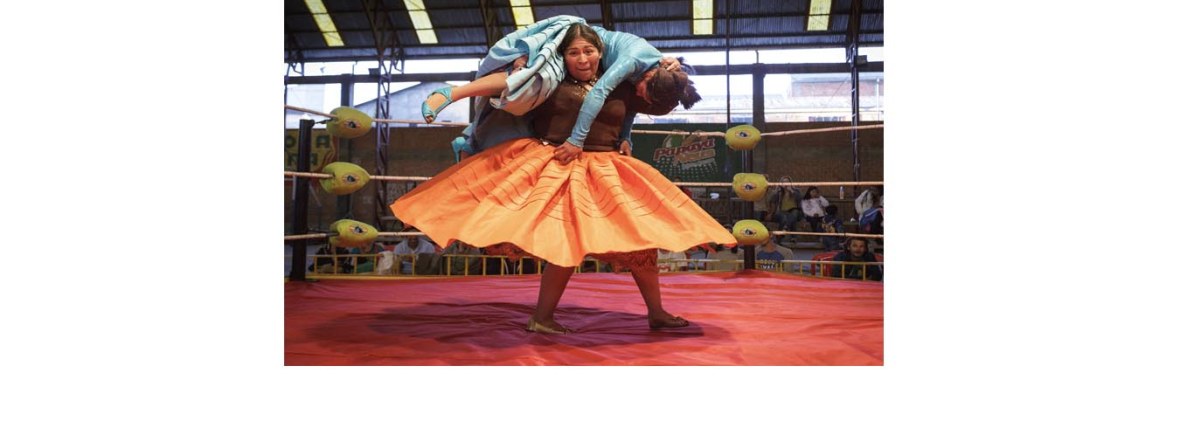
El Alto, Bolivia – it’s a Sunday evening in the ‘Multifunctional Coliseum’ of La Ceja. The venue is bustling with the shared excitement of women, men, and children, all waiting in anticipation as the ring announcer’s projected voice begins: “Señoras y señores, ¡presentemos a los Titanes del Ring!” Applause infects the audience as their cheers and shouts signal the beginning of a performance that they have waited all week to watch, a battle between las técnicas y las rudas, between good and evil, between two cholitas – between two women. Their bowler hats, embroidered shawls, and colourful clothing mark their presence within the auditorium. As they step into the ring, not only their energy but also their pride fills the space. We realise this is not just a simple fight of la lucha libre, it is a fight that re-writes the script as these cholitas luchadoras reclaim a place in society that is rightfully theirs, and that rightfully belonged to their predecessors who had been unfairly disregarded for far too long. “¡Vamos la lucha!”
The Fighting Cholitas are a group of female wrestlers, based in El Alto, a city near Bolivia’s capital of La Paz. They are part of ‘Titanes del Ring’ (Titans of the Ring) – a wrestling organisation of both men and women. Performing every Sunday at the Multifunctional Coliseum, these women attract hundreds of spectators, costing audience members just $1. They are indigenous women of almost entirely Aymara and Quechua descent and are recognised for their wardrobe of bowler hats and multilayered skirts (‘la pollera’), with braided hair and vibrant accessories that they wear in the ring. Rapidly becoming one of the must-see shows in Bolivia, they not only represent the empowerment of women, but also the empowerment of Bolivia’s indigenous peoples after decades of oppression. They essentially fight for their people’s respect both inside and outside of the ring.
People of Aymara and Quechua heritage have been heavily discriminated against for centuries. They suffered greatly during the Spanish colonial rule, subject to labour exploitation. Even before the Revolución boliviana of 1952, they continued to suffer severe ethnic oppression and were denied legal and political rights, and couldn’t even freely walk in the central square of La Paz. Despite the emergence of hope for acceptance after the Revolution of ‘52, they still suffered. They had scarce access to basic necessities such as sanitation, education and healthcare. Aymara and Quechua people were perennially precluded from living normal and healthy lives – they were refused the right to be humans. In these times, the terms ‘chola’ or ‘cholita’ were derogatory – signifying that they were of little to no worth. However, in 2006, three years after the removal of President Gonzalo Sanchez de Lozada, Bolivia elected its first indigenous president – Evo Morales. Morales’ commitment to protecting indigenous rights triggered positive change. Finally, Aymara and Quechua people were recognised with a true place in the world. They began to reclaim the once pejorative titles of ‘cholo’, ‘chola’, and ‘cholita’, transforming them into symbols of pride.
Now, instead of performing degrading tasks for the upper-class, the Fighting Cholitas showcase their skills for themselves, appreciated in their own right. Their titles and dress are now sources of power, rather than punitive labels.
Staged wrestling has grown in popularity since the 19th century in a number of countries. Wrestling known as ‘lucha libre’, meaning “freestyle fighting”, originated in Mexico, and is widely recognised by performers’ colourful masks and costumes, as well as its overexaggerated “high-flying” manoeuvres. This genre made waves across Latin America, including Bolivia, during the mid-20th century. Wrestling was for many years considered a sport not suited for women. But from the early 2000s women gradually integrated themselves within the art of lucha libre, eventually gaining more popularity than the men. The Fighting Cholitas started with the aim of battling domestic violence, and helping women who had been victims of the machismo culture, that is entrenched in Bolivia, to restore empowerment amongst themselves. The Fighting Cholitas gained acclaim and soon became members of the Titanes del Ring, with their performances garnering the most public appreciation and the most ticket sales. The group of fighting women even attracted international publicity as their iconic cholita fighting style and garb won the hearts of wrestling audiences around the world.
While it may at first appear to be a staged fight, put on between a good, clean-fighting ‘técnica’ and an evil, rule-bending ‘ruda’, by stepping up into the ring every Sunday evening, las luchadoras cholitas bolivianas are actively tearing down stereotypes of gender, race and class. They are forging paths to empowerment surrounded by their fellow fighting cholitas, both from the past and present, carrying with them their Aymara and Quechua heritage.
 Bulletin of Advanced Spanish