Sienna O’Keefe
Ana María Matute’s Pecado de omisión, though brief, makes an impact far greater than many longer works.
On first reading, I was unsettled by how much anguish could be compressed into so few words. Whilst the plot is simple – a shepherd boy is denied an education and dignity – there is an underlying commentary on class inequality and the unspoken violence of Franco-era Spain. It is a story that invites you to reflect long after you have finished reading it.
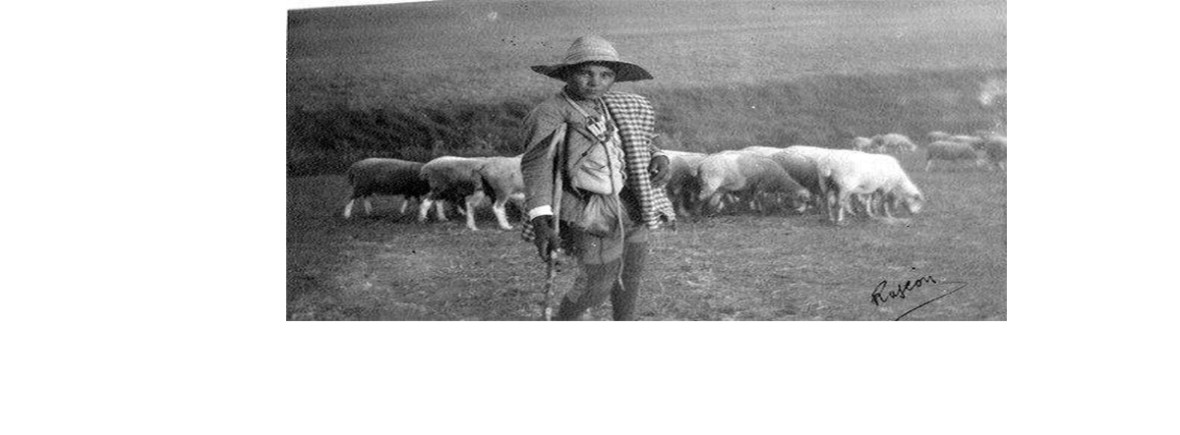
Pecado de omisión, published in 1961,tells how the orphan Lope is sent by his wealthy relative Emeterio to herd sheep in the remote pasture of Sagrado. “Te vas de pastor a Sagrado” – one terse sentence sees the wealthy relative banish the orphan boy to years of isolation in the mountains. “Te vas” underscores his absolute authority.
Lope is treated as a servant rather than family. There is no discussion, no attempt to educate him – he is quietly dismissed. Matute reinforces this exclusion through the barren landscape: “un azul profundo, terrible, ciego”. Nature here is not romantic, and cold nights and silence replace human contact. The setting serves as a metaphor for the barren emotional landscape shaped by poverty and social neglect. Aileen Dever notes that “Lope can accomplish nothing meaningful, like so many living under Franco.” 1
Lope’s sleeping quarters are subhuman. The mud hut symbolises how his status has been reduced to that of an animal. He even enters it on all fours: “En el chozo sólo cabían echados y tenía que entrar a gatas, medio arrastrándose. Pero se estaba fresco en el verano y bastante abrigado en el invierno”.
Janet Díaz observes that “under Franco’s regime, Spanish authors, in order to publish, were forced to exercise self-censorship, or to disguise their messages behind symbols, allegories, and other tricks to mislead the censors”.2 By her use of symbolism, Matute manages to evade the censors. It seems likely that Emeterio symbolises Franco, whilst Lope (from lupus, “wolf”) is cast as a lone, near-feral survivor.
Lope is a character who should embody the fresh possibilities of a reborn Spain, yet shut away in his hovel“con la techumbre de barro encima de los ojos”, he grows older without advancing. He is a striking image of the wasted potential, discrimination and enforced stagnation endured by countless victims of Franco’s dictatorship.
By contrast, Emeterio is a man of status and power, with no financial need to send Lope away: “Emeterio era el alcalde y tenía una casa de dos pisos asomada a la plaza del pueblo, redonda y rojiza bajo el sol de agosto”.

Years of isolation follow, until, as a young man, Lope descends to the village and sees Manuel, his former schoolmate. He was academically superior to Manuel at school, but Manuel is now the refined version of what Lope might have become. He offers Lope a cigarette from a case of polished silver. Lope notes the contrast in their fingers – a fine, delicate hand, as opposed to his own heavy, clumsy hand: “Qué rara mano la de aquel otro: una mano fina, con dedos como gusanos grandes, ágiles, blancos, flexibles. Qué mano aquélla, de color de cera, con las uñas brillantes, pulidas. Qué mano extraña: ni las mujeres la tenían igual”.
The short story builds to the point where Lope suddenly picks up a stone and kills Emeterio: “Lentamente, Lope la cogió entre sus manos”. Matute’s simple verb – cogió– strips the moment of ornament. The rock is red, symbolising his anger. Matute offers no dramatic build up and no psychological explanation: the silence of the narrative echoes the years of silence endured by Lope and his cries for everything he has missed out on – care, education, justice, and the life a young man deserved. The pious village women howl at him in fury: their indignant assertions that Lope owed a debt of gratitude to Emeterio is hypocritical, in keeping with the society in which they were living, where the reality perceived by many was far from what truly transpired.
The title Pecado de omisión suggests a failure to do what is morally required. Lope commits a sin by killing, yet Emeterio commits the first sin by denying Lope the life he deserved. Whom should the reader consider to be the one who bears responsibility? The boy who strikes, or the man who drove him to it? The reader is left feeling haunted and bereft.
Bibliography
Dever, Aileen. “An analysis of Ana Maria Matute’s “Pecado de omisión” through the Lens of Francoist Spain.” L’Érudit Franco-Espagnol. 5. 2014.
Díaz, Janet. Ana Maria Matute. New York: Twayne, 1971. Print. 813 words excluding Bibliography.
Sienna O’Keefe attends Westminster School where she is studying Spanish, Latin, History of Art and Maths for A-Levels. She hopes to read Spanish at university.
 Bulletin of Advanced Spanish